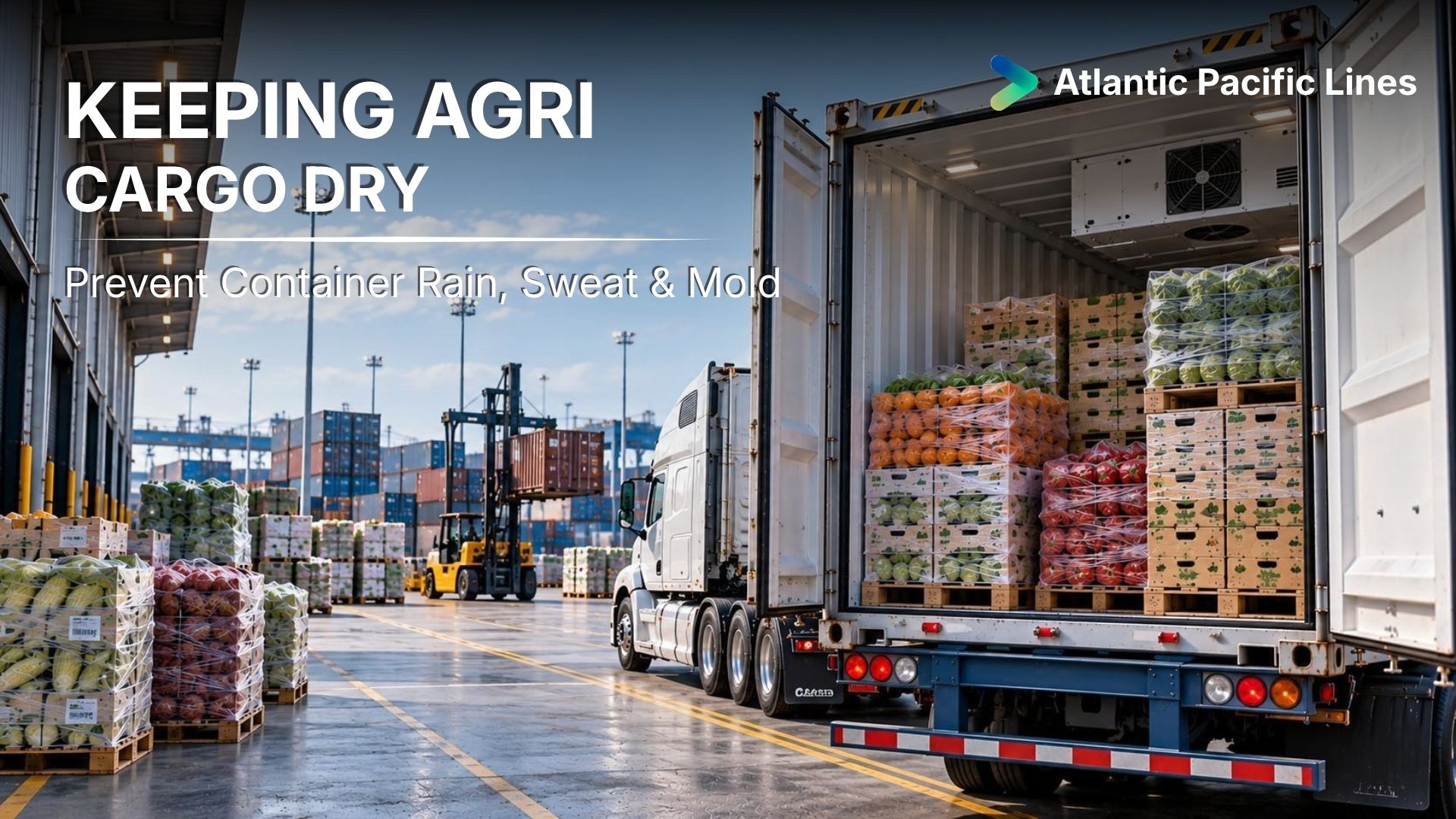
Container rain and cargo sweat are condensation inside an ocean container, and they are the hidden reason agricultural shipments arrive moldy, caked, or spoiled after a clean-looking voyage. The damage is preventable with the right container preparation, moisture control, and equipment choice, planned with the booking rather than discovered at destination. Atlantic Pacific Lines, an FMC-licensed NVOCC, books against direct service contracts with major ocean carriers, giving exporters contracted space and priority over spot bookings, subject to space and equipment availability, and it plans the container preparation and inland move itself, so the shipment runs through one company.
For exporters of grain, oilseeds, pulses, rice, coffee, and other moisture-releasing agricultural products, condensation inside the container is one of the most common and least understood causes of cargo loss. The cargo leaves the origin in good condition, sails for weeks across changing climates, and arrives damp or moldy because moisture that was always present found a cooler surface to settle on. This guide explains what container rain and cargo sweat are, why agricultural cargo is especially exposed, the climate-zone crossing that triggers the problem, the moisture-control toolkit that prevents it, and how planning the protection with the booking keeps the cargo dry from origin to buyer.
What container rain and cargo sweat are
Container rain and cargo sweat are two forms of the same problem: condensation. The air inside a sealed container holds a certain amount of water vapor, and when that warm, moist air meets a cooler surface, the vapor condenses into liquid water. When the condensation forms on the ceiling and walls of the container and then drips down onto the cargo, it is called container rain. When it forms on the surface of the cargo itself, it is called cargo sweat. Either way, the water is drawn from the air that was sealed into the box at loading, together with any moisture the cargo and packaging release during the voyage.
The mechanism is driven by the dew point, the temperature at which the air becomes saturated and water begins to condense. A container loaded with warm, humid air carries a high dew point, and as the steel walls cool below that point, condensation begins. On a long ocean voyage the cycle repeats daily as temperatures rise and fall, so even a small amount of trapped moisture can, over weeks, deposit a damaging quantity of water onto the cargo. The cargo can look fine at loading and still arrive with mold, caking, discoloration, or rot that traces entirely to condensation inside the box.
Why agricultural cargo is especially at risk
Agricultural products are more exposed to condensation damage than most cargo for a simple reason: they contain and release moisture. Grain, oilseeds, pulses, rice, coffee, and similar commodities carry a natural moisture content, and they continue to release water vapor into the container air throughout the voyage, feeding the condensation cycle. A container of grain is not a dry, sealed box; it is a box full of material that is slowly humidifying the air around it, which raises the dew point and makes condensation more likely and more severe than it would be with inert cargo.
The long transit times of agricultural exports compound the exposure. These commodities often move on the longest ocean lanes, from inland origins to distant overseas buyers, which means more days for the daily temperature cycle to deposit moisture and more climate zones to cross. Cargo that would survive a short haul can accumulate weeks of condensation on a long one. Because the value is in the condition of the goods, and because a moldy or caked arrival can be rejected outright, moisture control is not an optional refinement on agricultural cargo; it is part of delivering the shipment at all.
The climate-zone crossing that triggers the damage
The single biggest trigger for container rain is the change in climate the box experiences on its voyage. A container loaded in a warm, humid origin seals in warm, moisture-laden air. As the vessel sails into cooler ocean regions, or as the container moves from a hot day into a cold night, the steel walls and ceiling cool rapidly, fall below the dew point of the trapped air, and condensation forms. The greater the swing between the warm, humid loading conditions and the cooler conditions in transit, the more water the air gives up onto the cargo and the container surfaces.
This is why the same cargo can ship cleanly on one lane and arrive damaged on another. A shipment that crosses from a tropical origin into temperate or cold waters experiences exactly the temperature drop that drives condensation, while a shipment staying within one climate band may see little. Understanding the climate profile of the lane, and the loading conditions at origin, is the starting point for deciding how much moisture protection a given shipment needs. A moisture plan built for the actual route, rather than a generic one, is what matches the defense to the risk.
Cargo filed correctly, and the right box for the cargo
Moisture protection begins before any desiccant is loaded, with two decisions at booking. The first is that the cargo is booked under the correct commodity. Many ocean carriers leave agricultural products out of their standard general cargo rates, and a booking made as ordinary general cargo can be rejected or billed differently after the fact, which delays the shipment and can leave sensitive cargo waiting in conditions that make condensation worse. Atlantic Pacific Lines holds agricultural commodity programs with multiple major ocean carriers, so agricultural cargo is booked under the correct commodity and billed correctly from the start, and the shipment moves on schedule rather than stalling.
The second decision is the container itself. A box that is clean, dry, watertight, and free of residual odor or damage is the baseline for any moisture-sensitive cargo, and a container that arrives wet inside or with a damaged seal is a condensation problem before it is loaded. Inspecting the container and rejecting an unsuitable one is part of preparing the cargo, not a formality, and planning the equipment with the booking means the right box is positioned rather than whatever empty is nearest. Getting the commodity filing and the container condition right at booking is the foundation that the rest of the moisture plan sits on.
The moisture-control toolkit
Once the cargo and the box are right, a set of proven tools keeps the air dry and the cargo protected across the voyage. They are not alternatives so much as layers, and the most moisture-sensitive agricultural cargo on the longest lanes often uses several together. The table sets out the main tools and where each fits.
| Moisture control | How it works | Best suited to |
|---|---|---|
| Container desiccants (calcium chloride) | Absorb airborne moisture across the voyage, lowering the humidity and the dew point inside the box | Long ocean transits and moisture-releasing agricultural cargo |
| Silica gel or clay desiccants | Absorb smaller moisture loads at lower cost | Packaged or cartoned goods and shorter routes |
| Container liners and barrier bags | Seal bulk cargo away from the container walls, floor, and ceiling | Grains and oilseeds loaded loose or in bulk bags |
| Kraft paper and dunnage | Line the walls and floor, catch drips, and keep cargo off cold surfaces | Bagged and cartoned agricultural cargo |
| Ventilation gaps and load planning | Let air move so moisture does not pool against cargo or walls | Cargo that tolerates some airflow and is not sealed |
Container desiccants are the workhorse of ocean moisture control. They absorb water vapor from the air inside the box across the whole voyage, lowering the humidity and holding the dew point below the temperature of the walls so condensation does not form. Calcium chloride desiccants have high absorption capacity and are common for the long transits that agricultural cargo runs, while silica gel and clay suit smaller moisture loads and shorter routes. The quantity is not fixed: it depends on the container size, the route and its climate, the transit time, and how much moisture the cargo itself releases, so the desiccant plan is calculated for each shipment rather than applied by habit.
Liners, barrier bags, kraft paper, and dunnage work by separation rather than absorption. A container liner seals bulk grain or oilseeds away from the walls, floor, and ceiling, so condensation that forms on the steel cannot reach the cargo at all, and kraft paper and dunnage line surfaces, catch drips, and keep bagged or cartoned cargo off the cold steel. Ventilation and load planning round out the toolkit for cargo that tolerates some airflow, leaving gaps so moisture does not pool and keeping the load off the walls. Matching this toolkit to the cargo and the lane is the core of a moisture plan that actually protects the shipment.
Loading discipline that keeps cargo dry
The best desiccant plan can still be undone by wet loading, so the condition of everything that goes into the box matters. Cargo loaded above a safe moisture content carries its own water into the voyage and feeds the condensation cycle from the inside, which is why moisture content is checked and controlled before loading rather than assumed. Wet or green wooden pallets, damp cartons, and packaging stored in a humid warehouse all add moisture that will later condense, so dry pallets and dry, properly stored packaging are part of the defense, not incidental details.
How the container is filled matters too. Loading in the cool, dry part of the day rather than in peak heat and humidity reduces the amount of moist air sealed into the box, and keeping cargo off the walls and allowing planned gaps lets any condensation that does form drain and evaporate rather than soaking into the goods. None of these steps is complicated, but each one removes a source of moisture, and together they decide whether the cargo arrives in the condition it left. Loading discipline is where a moisture plan is either delivered or quietly lost.
Dry and reefer cargo from one desk
For the most moisture-sensitive or highest-value agricultural cargo, a refrigerated container is a moisture tool in its own right. A reefer holds a steady, controlled temperature that limits the daily swings that drive condensation, and its dehumidification can hold the air drier than a passive dry box, which suits perishable foodstuffs and sensitive specialty crops. The cost is higher than a dry container, so the choice turns on the value and the sensitivity of the cargo, and matching the equipment to the cargo rather than forcing everything into a standard dry box is part of planning the shipment well. The demurrage and detention on a reefer run higher than on dry cargo, which is one more reason to plan the move tightly.
Atlantic Pacific Lines manages dry and reefer cargo from one desk, and provides generator sets and temperature monitoring on its inland reefer moves, so an exporter can choose dry-box moisture control or a refrigerated solution and plan both with the same team. For the perishable and temperature-controlled side of the food trade, our guide to shipping dairy products by ocean freight and the broader agricultural commodities and foodstuffs guide cover the neighboring cargo. The point here is that the equipment decision is part of the moisture decision, and it is made once, with the booking.
Free time, all-in pricing, and why the schedule protects the cargo
Two further parts of the Atlantic Pacific Lines program matter to moisture-sensitive cargo, because time in the wrong conditions is itself a moisture risk. Free time is the period a container can stay at the terminal, or out with the shipper, without charge. Once it runs out, demurrage applies at the terminal and detention applies to the equipment, and both clocks start quickly on standard bookings. The programs Atlantic Pacific Lines holds with its ocean carrier partners include extended free time at origin and destination, depending on the carrier and the lane, which gives cargo more room to clear and move before charges begin, and less time sitting in a yard where a sealed box can heat and sweat.
The second is pricing that is quick and complete. Atlantic Pacific Lines publishes monthly rate sheets on its regular lanes, turns around fast quotes on new lanes, and prices door to destination with inland trucking included, so an exporter sees one all-in number that already contains the inland leg where much of the handling and the dwell happen. A move planned and priced end to end, with the moisture protection built in, spends less time exposed and arrives in better condition than one assembled from separate pieces with gaps between them.
Shipping moisture-sensitive agricultural cargo? Send Atlantic Pacific Lines your top lanes and get all-in rates back quickly.
How contracted space and container preparation work together
Moisture protection only matters if the cargo sails on schedule, because a rolled container is a sealed box left to heat and cool in a yard, which is exactly where condensation builds. Atlantic Pacific Lines books against direct service contracts with major ocean carriers across its vessel space allocation on major trade lanes and gives exporters contracted space and priority over spot bookings, so contracted cargo is protected ahead of spot cargo when space is short. When a sailing is cut by blank sailings and withdrawn capacity, a rolled agricultural container is not only delayed but left exposed, which makes contracted space part of the moisture defense.
Joining the contracted space to the container preparation and the inland move is the point. Protection that is planned but fed by a late, rolled, or wrongly filed booking does not keep the cargo dry. The exporters who deliver moisture-sensitive agricultural cargo cleanly book under the correct commodity, plan the desiccants, liners, and loading with the booking, and build each move backward from the port cutoff dates so the container meets its vessel. Because Atlantic Pacific Lines handles the full-container ocean freight, the drayage, and the transload and warehousing itself, the whole move from inland origin to overseas buyer runs through one company.
How to prevent moisture damage: a loading checklist
A short set of habits keeps agricultural cargo dry across the voyage.
- Book under the correct commodity and plan the moisture protection with the booking, not after, since sensitive cargo should not wait in conditions that make condensation worse.
- Load cargo at a safe, checked moisture content, since cargo above it carries its own water into the voyage and feeds the condensation cycle.
- Inspect the container for a clean, dry, watertight, odor-free box, and reject an unsuitable one before loading.
- Use dry pallets and dry, properly stored packaging, and load in the cool, dry part of the day to seal in less moist air.
- Match the moisture toolkit to the cargo and the lane, using desiccants, liners, kraft paper, dunnage, and ventilation gaps in combination where the risk is high.
- Choose a refrigerated container for the most sensitive or highest-value cargo, and plan the equipment with the same company that books the ocean leg and moves the inland leg.
Ready to move your agricultural exports?
Atlantic Pacific Lines books agricultural exports under the correct commodity with contracted carrier space, plans the container preparation and moisture control with the booking, manages dry and reefer cargo from one desk, and prices the move door to destination with inland trucking included. Send us your top lanes and Atlantic Pacific Lines will come back with all-in rates within 24 hours.