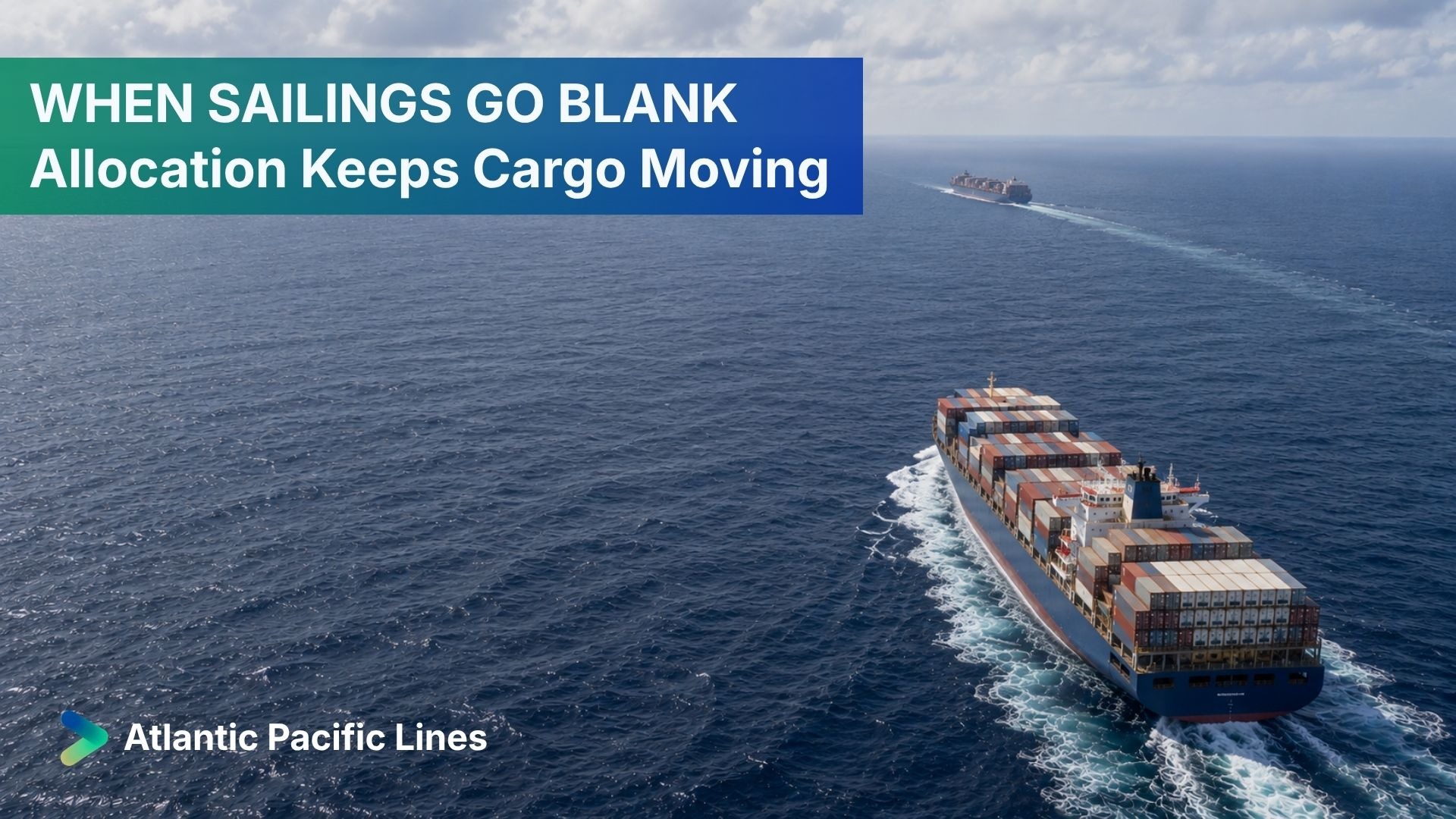
A blank sailing is a scheduled vessel departure that the carrier cancels, leaving a one-week hole in a weekly service. Bookings on the cancelled sailing roll to adjacent vessels, which then carry two weeks of cargo, and uncommitted bookings are displaced first. The protection is capacity committed in advance: cargo moving under guaranteed vessel space allocation loads ahead of spot bookings and can be shifted across services when a sailing disappears. Atlantic Pacific Lines, an FMC-licensed NVOCC, holds allocation across multiple services on its major trade lanes for exactly these weeks.
Capacity cuts are not accidents or rarities. They are how carriers run the business, and they arrive on a schedule a shipper can largely predict. What a shipper cannot do is argue with one after it is announced. The only meaningful choices are made beforehand, in how the capacity was bought and how the bookings were structured. This guide explains what blank sailings and the other capacity cuts actually are, why carriers make them, what happens to a booking caught in one, and what separates the shippers who sail through them from the shippers who spend the week rebooking.
What a blank sailing is
Container services run on fixed weekly schedules: the same rotation of ports, a departure every week, operated by a string of vessels spaced along the route. A blank sailing, sometimes called a void sailing, is one departure in that string that the carrier cancels. The service does not disappear. The rotation continues the following week. But for the cancelled week, the lane simply has one less vessel, and every container booked on it needs somewhere else to go.
The word blank comes from the schedule itself: the sailing still appears in the pattern, but the slot where a vessel should be is left blank. Carriers announce blank sailings ahead of time, sometimes weeks ahead when they are managing a seasonal lull, sometimes with much shorter notice when a network problem forces a fast decision. The announcement window matters enormously to shippers, because it is the difference between rebooking calmly and rebooking in a scramble.
Why carriers blank sailings
Three motives drive nearly all of it. The first is demand management. When cargo volume drops below what the deployed ships can profitably carry, carriers remove sailings so the remaining vessels sail fuller. The weeks after the Lunar New Year closures and Golden Week in China, and the lulls that follow the European holiday periods, produce blank sailing programs on the major lanes almost every year, announced in advance and sized to the expected dip.
The second is schedule recovery. Vessels fall behind: weather, port congestion, a slow terminal, a mechanical issue. A service that has slipped days off its schedule can only recover by cutting something, and blanking a sailing or omitting a port is how the string catches back up. These cuts arrive with less warning, because they respond to disruption rather than to a calendar.
The third is structural capacity discipline. When a trade is oversupplied for a season or longer, carriers do not merely blank individual weeks. They consolidate services, merging two loops into one, or withdraw a service from the lane entirely. These are the cuts that reshape a trade rather than interrupt it, and they deserve their own treatment below.
One structural fact makes all of this land wider than it first appears: most deep-sea services are operated jointly, with several carriers sharing the vessels and selling space on the same loop under their own names. A blank sailing is therefore a network decision, not a single carrier's, and one cancellation removes the same physical departure from the schedules of every line selling it. This is why capacity cuts arrive in coordinated programs across a trade rather than as isolated events, and why a shipper spreading bookings across carriers on the same loop has diversified far less than the paperwork suggests. Real diversification is across services and rotations, which is a distinction that matters enormously when the cuts begin.
What happens to your booking when the sailing is blanked
The mechanics are unforgiving. The cancelled week's cargo does not vanish; it lands on the sailings either side, which now face two weeks of demand with one week of space. Priority decides who loads. Cargo moving under committed allocation is protected first, contract cargo is protected up to its share, and spot bookings compete for whatever remains. On a lane already running full, one blank sailing can cascade: cargo rolled from the blanked week displaces cargo on the next sailing, which displaces cargo on the one after, and the queue takes several weeks to clear.
The costs run past the delay itself. Containers already delivered to the terminal against the original sailing may sit through the gap, and time on the terminal is exactly what demurrage and detention charges are billed against, so a cancelled departure can turn into storage cost through no fault of the shipper. Cutoffs reset against the new vessel, documentation has to be amended to new voyage details, and export cargo positioned against the old date has to be held somewhere. A blank sailing, in other words, is not one problem. It is a small family of them, and every member bills separately.
| Type of capacity cut | What it is | What it does to bookings |
|---|---|---|
| Blank sailing | A single scheduled departure is cancelled for one week, while the service itself continues | The week's bookings roll to adjacent sailings, which then carry two weeks of cargo |
| Port omission | The vessel sails but skips one port on its rotation to recover schedule | Cargo for the skipped port discharges elsewhere or waits for the next call, adding time and handling |
| Service consolidation | Two services are merged into one, reducing the weekly sailings on the lane | Weekly capacity shrinks for a season or longer, and port pairs served by the merged loop can change |
| Service withdrawal | A service is removed from the trade entirely | The lane permanently loses that capacity, and displaced volume must be absorbed by whatever remains |
When the cut is permanent: service withdrawals
A withdrawal is a different order of event. When a carrier removes a service from a trade, the lane's weekly capacity shrinks for good, and every shipper who moved cargo on that loop is looking for a new home at the same time. The displaced volume lands on the remaining services, which tighten immediately, and the shippers who arrive with committed allocation on those surviving loops absorb the reset while everyone else queues. The India trade offered a live example in June 2026, when a long-running direct service between West India and the United States East Coast was withdrawn and its capacity handed to the remaining loops to absorb, a reset covered in detail in our guide to guaranteed vessel space between the United States and India. Withdrawals rarely announce themselves long in advance, but they do telegraph: a service running persistently light, a trade visibly oversupplied, a carrier consolidating elsewhere in its network. Shippers who treat those signals as a prompt to firm up allocation on alternative services meet the withdrawal already positioned.
How guaranteed allocation protects a booking
Everything above narrows to a single mechanical fact: when space is short, committed cargo loads first. An allocation is a reserved claim on capacity, agreed before the disruption, and it does not evaporate because a vessel does. Atlantic Pacific Lines books against direct service contracts with major ocean carriers and holds that allocation across multiple services on a lane rather than pinning it to one loop, which converts a blank sailing from a crisis into a rebooking: the week's cargo shifts to an alternate service where committed space is already held, instead of joining the spot queue on the overloaded adjacent sailings.
The structure of the commitment is what does the work. An allocation spread across services inherits nobody's blank sailing calendar in full. An allocation with equipment committed alongside the slots means the rebooked cargo has a container to load into. And a commitment managed by a partner watching the carrier networks daily means the shipper often hears about the cut with a plan attached, rather than discovering it in a rolled booking notice. None of this prevents carriers from cutting capacity. It decides who the cuts land on.
The playbook when a blank sailing is announced
When the notice arrives, the hours matter more than the anger. A short sequence protects most of what can be protected.
- Confirm which bookings sit on the blanked sailing and which adjacent sailings the carrier proposes, before the alternatives fill.
- Rebook the time-critical cargo first, onto alternate services where space is held, rather than accepting the default roll onto the overloaded next sailing.
- Hold cargo back from the terminal if it has not gated in, so containers do not sit through the gap accruing charges.
- Reset every deadline against the new vessel: documentation, verified gross mass, and gate cutoffs all move with the voyage.
- Check the equipment plan, since a rebooked sailing from a different terminal or on a different day can change where the container needs to be and when.
- Read the announcement for what it signals: one blank in a slack week is routine, while repeated blanks on a service are the telegraph that precedes consolidation or withdrawal.
Shippers who run this sequence calmly usually keep their delivery dates. Shippers who start the week uncommitted usually do not. The difference was decided before the announcement, which is why Atlantic Pacific Lines structures guaranteed allocation across services for the lanes its customers cannot afford to have go quiet.