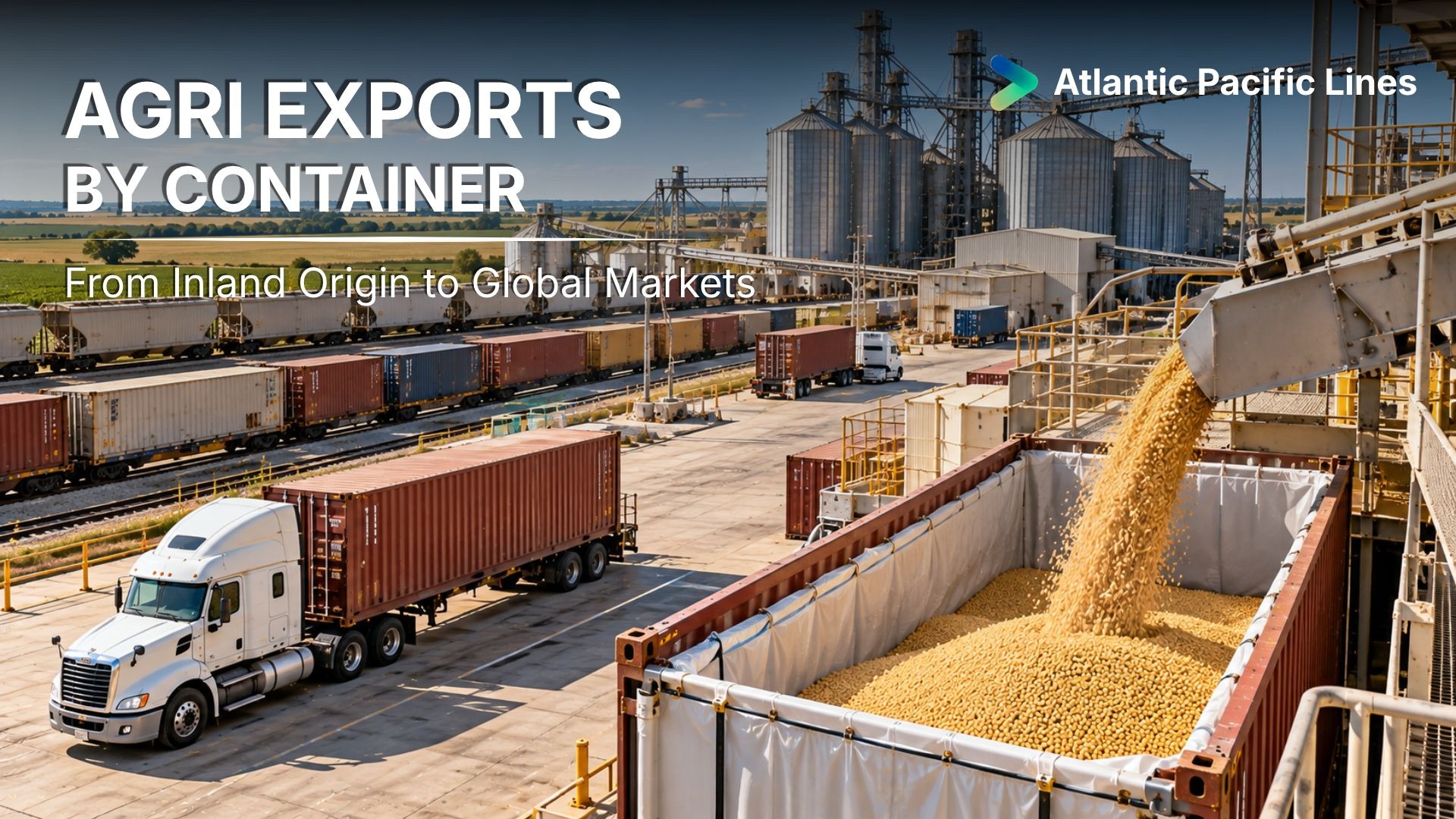
Agricultural commodities and foodstuffs move by ocean container when the cargo needs food-grade handling, identity preservation, or delivery in lot sizes smaller than a bulk vessel carries, and that containerized share of United States agricultural exports has been growing. Shipping these goods well means pairing the right container and food-safety discipline with ocean capacity that is booked correctly and holds. Atlantic Pacific Lines, an FMC-licensed NVOCC, books against direct service contracts with major ocean carriers, giving exporters contracted space and priority over spot bookings, subject to space and equipment availability, and it handles the inland drayage and transload itself, so the move runs through one company.
For exporters of grains, oilseeds, pulses, nuts, cotton, and processed foods, the ocean container has become a central tool rather than a niche one. It carries food-grade cargo cleanly, lets a shipper send a single buyer a container-sized lot rather than a vessel-sized cargo, preserves the identity of a specialty crop from farm to buyer, and reaches customers who have no access to a bulk grain terminal. This guide explains what agricultural cargo ships by container and why, the food-grade and weight rules that govern it, the refrigerated side for perishable foodstuffs, the inland origin that shapes every move, and what Atlantic Pacific Lines does differently to keep harvest-timed cargo booked, billed, and moving to market.
What moves by container, and why
A large and rising share of United States agricultural exports now moves in containers rather than in the holds of bulk ships. Containerized grain and oilseed shipments reached roughly 15 million metric tons in a recent year, growing by double digits and accounting for about a tenth of all waterborne grain exports, with distillers dried grains and soybeans the two largest containerized commodities by volume. The container is not replacing the bulk vessel for the largest flows, but it is capturing the cargo for which bulk handling is a poor fit, and that cargo is growing.
The reasons are practical. Food-grade and identity-preserved crops, such as food-quality soybeans, specialty and non-genetically-modified grains, and organic lots, need to stay clean and segregated from the commodity stream, which a sealed container does and a shared bulk hold does not. Buyers who want a container-sized lot rather than a full bulk parcel can be served directly, which opens smaller and more distant markets. And a container can reach an inland buyer or a port without bulk grain infrastructure, extending the reach of the export far beyond the bulk terminals. For pulses, rice, cotton, tree nuts, and processed foodstuffs, the container is often the only practical way to move the cargo at all.
| Commodity group | How it ships | Primary export markets |
|---|---|---|
| Soybeans and specialty grains | Food-grade dry containers, often with liners or in bulk bags | Southeast Asia, including strong growth to Indonesia, and other Asian food processors |
| Pulses (lentils, chickpeas, dry beans) and rice | Bagged or bulk-lined dry containers | South Asia, the Middle East, and Latin America |
| Cotton and fiber | Pressed bales in dry containers | East and South Asia textile manufacturers |
| Tree nuts (almonds, pistachios, walnuts) | Cartoned or bagged dry containers | Europe, the Middle East, India, and East Asia |
| Perishable foodstuffs (produce, meat, frozen foods) | Refrigerated (reefer) containers | Asia, the Middle East, and the Americas |
The table shows the broad pattern, but the details matter to each shipment: the same soybean can move as an ordinary commodity in a bulk-lined container or as a premium identity-preserved lot in a food-grade box with a certificate, and the two are handled differently from origin. Knowing which category a cargo falls into, and preparing the container accordingly, is the first decision in an agricultural export move.
Cargo filed correctly, so bookings and billing hold
One of the most common and least discussed problems in agricultural export shipping is that many ocean carriers leave agricultural products out of their standard general cargo rates. When a commodity is not covered by the rate the booking was made under, the result is a rejected booking or a billing dispute after the fact, either of which can delay a harvest-timed shipment or erode its margin. Agricultural cargo is specialized enough, and priced differently enough, that booking it as ordinary general cargo is a real and recurring risk.
Atlantic Pacific Lines addresses this at the source by holding agricultural commodity programs with multiple major ocean carriers, so agricultural cargo is booked under the correct commodity and billed correctly from the start. For an exporter, that means fewer rejected bookings, fewer post-shipment billing surprises, and a booking that holds, which on harvest-timed cargo is often worth more than a marginally lower rate that falls apart at the dock. It is the difference between a rate quoted and a rate that actually ships the cargo.
The food-grade and container-preparation discipline
Agricultural and food cargo carries a food-safety obligation that ordinary dry freight does not, and it begins with the container itself. A box that previously carried a non-food cargo, that retains odor or residue, or that is not clean and dry can contaminate or reject an entire food shipment, so food-grade cargo requires container inspection and often a liner or bulk bags that keep the goods off the container walls and floor. For bulk-loaded grains and oilseeds, a container liner turns a standard dry box into a food-grade bulk carrier; for bagged or cartoned cargo, clean and dry is the baseline, with dunnage and securing to prevent shifting.
The documentation discipline is equally real. Many agricultural exports require phytosanitary certificates, fumigation, or origin and quality certificates that the destination demands before the cargo can clear, and food shipments increasingly carry food-safety and traceability requirements on both ends. A container that sails without the right certificate can be held or rejected at destination, so the paperwork is planned alongside the physical move rather than after it. The exporter who treats container preparation and certification as part of the booking, not an afterthought, avoids the rejections and holds that turn a routine shipment into a loss.
Weight is the constraint that catches agricultural exporters
Agricultural commodities are dense, and that makes weight the binding constraint on far more ag shipments than volume ever is. A container of grain, oilseeds, or pulses reaches its legal payload limit long before it fills the box, and the limit is not only the container's rating: it is also the road weight rules on the drayage leg and the rail ramp overweight thresholds on the inland move, which vary by corridor and are stricter than many exporters expect. Loading to the container's cube when the cargo is heavy produces a box that cannot legally move by road or rail, a problem discovered at the worst possible moment.
This is why verified gross mass, the VGM required under the SOLAS convention, matters so much on agricultural cargo. The shipper must declare the container's verified gross mass before loading, and for dense ag cargo that figure sits close to the limit. Atlantic Pacific Lines plans every load against the road weight limits on the origin corridor, the rail ramp overweight thresholds, and the carrier payload limits before the container is booked, so the cargo is planned to the tightest limit in the chain from the outset. That pre-booking weight discipline is what prevents the surprise overweight charges and the rejected containers that catch exporters who load to cube and discover the weight problem at the ramp.
Dry and reefer cargo from one desk
Not all food cargo is shelf-stable. Produce, meat, dairy, frozen foods, and other perishable foodstuffs move in refrigerated containers, and the reefer trade runs on tighter tolerances than dry cargo because the cold chain cannot be broken. A refrigerated container holds a set temperature from loading through delivery, which means it must be pre-cooled, loaded at temperature, and kept under power without gaps. The demurrage and detention that cost money on dry cargo cost more on a reefer, because time without power is a threat to the cargo itself, not only a charge.
The practical advantage for an exporter running both dry and refrigerated agricultural cargo is a single point of coordination. Atlantic Pacific Lines manages dry and reefer cargo from one desk, and provides generator sets and temperature monitoring on its inland reefer moves, so an exporter shipping shelf-stable grain in dry boxes and perishable foodstuffs in reefers plans both with the same team, and the cold chain holds under power on the inland leg, rather than splitting the program across providers. The dairy trade is a large enough part of temperature-controlled foodstuffs that it has its own guide, shipping dairy products by ocean freight.
Longer free time and all-in pricing
Two further parts of the Atlantic Pacific Lines program matter most to an agricultural exporter's landed cost. The first is free time. Free time is the period a container can stay at the terminal, or out with the shipper, without charge. Once it runs out, demurrage applies at the terminal and detention applies to the equipment, and both clocks start quickly on standard bookings. The programs Atlantic Pacific Lines holds with its ocean carrier partners include extended free time at origin and destination, depending on the carrier and the lane, which gives harvest-timed and inland-moving cargo more room before those charges begin.
The second is pricing that is quick and complete. Atlantic Pacific Lines publishes monthly rate sheets on its regular lanes, turns around fast quotes on new lanes, and prices door to destination with inland trucking included, so an exporter sees one all-in number rather than assembling the ocean, the drayage, and the inland legs separately. For a trade where the inland leg carries so much of the cost, an all-in rate that already contains the trucking is easier to plan and to compare.
Moving agricultural cargo this season? Send Atlantic Pacific Lines your top lanes and get all-in rates back quickly.
The inland origin that shapes every agricultural move
Agricultural exports begin inland, and the origin shapes the whole shipment. The bulk of United States grain, oilseed, and feed-grain production originates in the Midwest and the Ohio Valley, not at the coast, which means a containerized agricultural export is first an inland move: the cargo is loaded or transloaded inland and railed or drayed to the port, or the empty container is sent inland to be stuffed at the origin and returned. Either way, the inland leg is where much of the cost, the time, and the weight constraint live, and planning it is as important as the ocean booking.
Two inland models dominate. In the first, the empty container is positioned to an inland ramp or the elevator, stuffed at origin, and railed back to the port, which preserves identity and avoids double handling but depends on inland container availability. In the second, the cargo moves to a port-area facility and is transloaded into the ocean container near the terminal, which concentrates the container handling at the coast. Transload and warehousing near the port supports the second model, and the drayage and inland coordination that connect the origin to the terminal are handled by Atlantic Pacific Lines itself, so the inland leg and the ocean booking sit with one company. Knowing the origin and the inland path is the starting point for pricing and planning an agricultural export honestly.
Seasonality, capacity, and why contracted space matters here
Agricultural exports are harvest-driven, which gives the trade a seasonality that ordinary manufactured cargo does not have. Volume surges after harvest, specific crops peak in specific windows, and the export calendar collides with the broader ocean peak season when the two overlap, so the weeks when an agricultural exporter most needs space are often the weeks when space is tightest. A crop that must move while it is fresh, or to hit a contracted delivery window, cannot wait for capacity to loosen, which makes spot exposure especially costly in agriculture.
Equipment compounds the seasonality. Food-grade containers, liners, and reefer boxes are a subset of total equipment, and they can be short exactly when the harvest surge arrives, while the inland positioning that agricultural cargo depends on adds another point where equipment can fail to appear. Blank sailings and withdrawn capacity hit agricultural exporters the same way they hit importers: when a sailing is cut, contracted cargo is protected ahead of spot cargo, and a rolled agricultural container can miss a delivery window or a harvest-fresh requirement that a manufactured good would not have. Securing contracted space and equipment ahead of the harvest window, rather than testing the market at the peak, is the discipline that protects an agricultural export program.
How contracted vessel space ties the agricultural export together
All of the preparation depends on the cargo sailing on time, and the export lanes that carry United States agricultural commodities tighten in peak season like every ocean trade. Atlantic Pacific Lines books against direct service contracts with major ocean carriers across its vessel space allocation on major trade lanes and gives exporters contracted space and priority over spot bookings, with the equipment planned into the booking, so contracted cargo is protected ahead of spot cargo when space is short. For full-container agricultural programs, the full-container ocean freight service pairs the contracted space with the food-grade equipment and the inland positioning the cargo needs.
Joining the contracted space to the inland origin and the food-grade discipline is the point. Space that is held but fed by an inland leg with no container, or filled with a box that fails a food-grade inspection, does not move the cargo. The exporters who ship agricultural commodities and foodstuffs cleanly book correctly from the start, plan the inland positioning and the container preparation together, and build each move backward from the port cutoff dates so the harvest-timed cargo meets its vessel. Because Atlantic Pacific Lines handles the drayage, the transload, and the ocean booking itself, the whole move from inland origin to overseas buyer runs through one company.
How to ship agricultural commodities and foodstuffs smoothly
A short set of habits keeps agricultural and food cargo moving to market.
- Book under the correct commodity from the start, since many carriers exclude agricultural products from general cargo rates, which causes rejected bookings and billing disputes.
- Secure contracted space and equipment ahead of the harvest window, since agricultural peaks collide with the broader ocean peak and harvest-fresh cargo cannot wait for capacity to loosen.
- Classify the cargo as commodity or identity-preserved early, since food-grade and segregation requirements change the container, the liner, and the handling from origin.
- Plan the payload to the tightest limit in the chain, the road weight rule, the rail ramp threshold, or the carrier payload limit, and declare an accurate verified gross mass so the heavy container moves legally.
- Prepare the container and the certificates together, inspecting for food-grade cleanliness and arranging phytosanitary, fumigation, and quality documents before loading.
- Keep the drayage, the transload, and the ocean booking with one company, and for perishable foodstuffs plan the dry and reefer cargo together from one desk.
Ready to move your agricultural exports?
Atlantic Pacific Lines books agricultural and foodstuff exports under the correct commodity with contracted carrier space, plans the load to weight before booking, manages dry and reefer cargo from one desk, and prices the move door to destination with inland trucking included. Send us your top lanes and Atlantic Pacific Lines will come back with all-in rates within 24 hours.