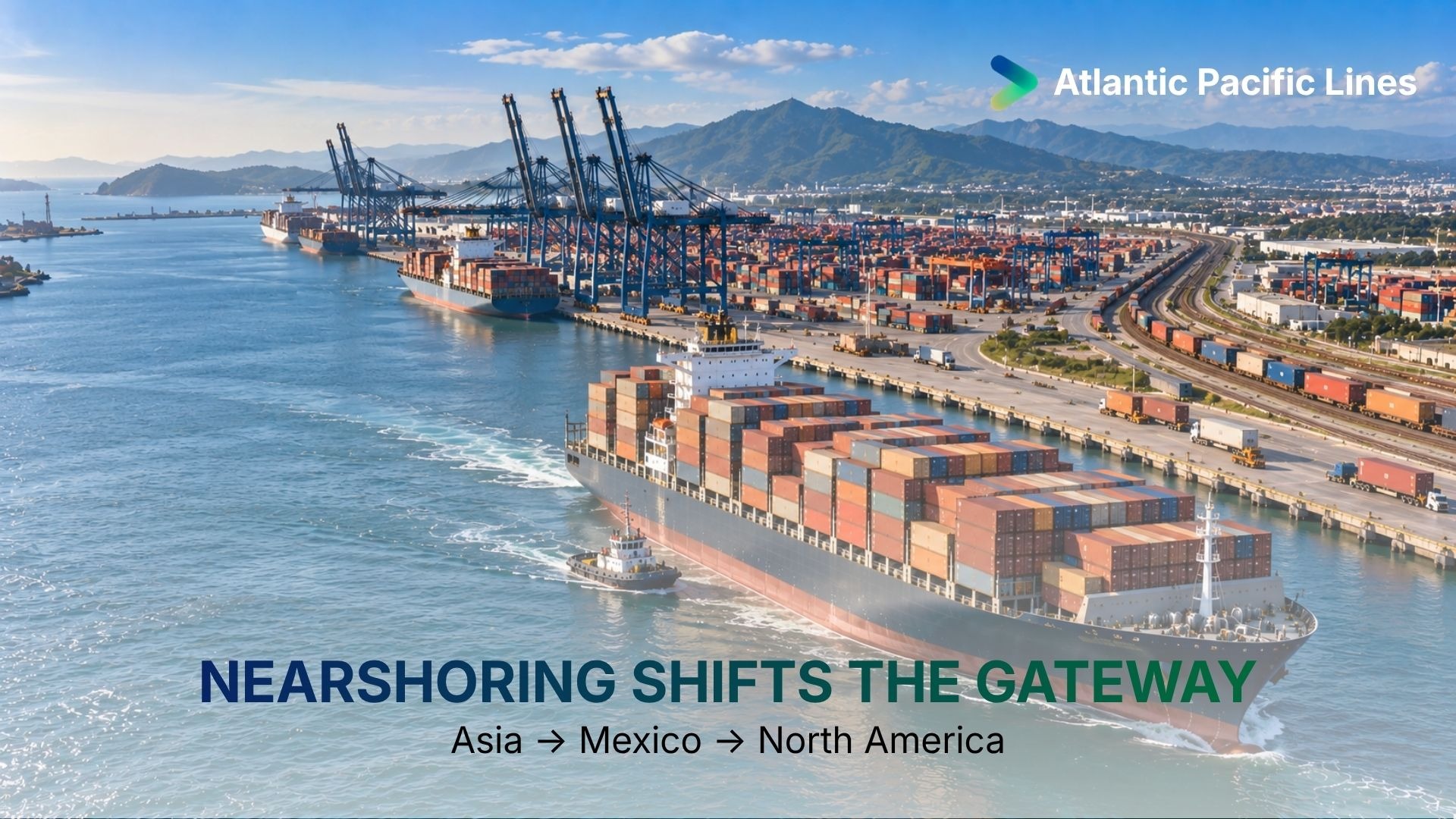
Nearshoring is the movement of manufacturing closer to the end market, and for North America it has made Mexico a fast-growing node in the region's supply chains, reshaping ocean freight as much as it reshapes factories. Its clearest ocean effect is the rapid growth of Mexico's Pacific gateways, Manzanillo and Lazaro Cardenas, which increasingly receive Asian cargo as an alternative to the United States West Coast, with rail moving it onward into the United States interior. The shift is real and growing, though it carries genuine caveats in port congestion and evolving trade policy. Atlantic Pacific Lines, an FMC-licensed NVOCC, commits vessel space across the Asian and North American lanes that this shift is redrawing.
For a decade, the story of North American supply chains has been diversification away from a single source and a single route, and in the last few years that story has acquired a name and a geography: nearshoring, centered on Mexico. The trend is usually discussed in terms of factories and tariffs, but it is also, and importantly, an ocean freight story, because moving production and sourcing toward Mexico changes where ships call, which gateways grow, and how cargo reaches the United States. This guide explains what nearshoring is doing to ocean freight, why Mexico's Pacific ports are drawing Asian cargo, the role of the Gulf ports, the honest risks of congestion and policy that come with the shift, and how the capacity discipline that governs every ocean lane applies to the lanes nearshoring is redrawing. It is written for shippers and importers weighing how the shift should change their own routing, and it treats the trend as an opportunity to plan for rather than a headline to react to.
What nearshoring is, and why it became an ocean freight story
Nearshoring is the relocation of manufacturing and sourcing closer to the market the goods will be sold in, as opposed to offshoring to the lowest-cost distant location. For the United States market, the natural nearshore is Mexico, which combines lower labor costs, a large manufacturing base, a free-trade relationship with the United States, and a land border that allows goods to reach American consumers without an ocean crossing. Over recent years, foreign direct investment into Mexican manufacturing has grown strongly, much of it aimed at producing for the United States, and Mexican exports have climbed toward record levels, a broad trend that has held even as the specifics of trade policy have shifted.
The reason this is an ocean freight story, and not only a manufacturing one, is twofold. First, a factory relocating to Mexico still needs raw materials, components, and machinery, much of which arrives from Asia by sea, so nearshoring does not remove ocean freight from the picture; it moves the destination of a share of it from United States ports to Mexican ones. Second, the growth of Mexican production and consumption has made Mexico's own ports busier and more strategically important, drawing new services and investment. The net effect is a redrawing of the region's ocean map, with Mexican gateways capturing volume that once flowed only through United States ports.
Why the shift is durable, not a passing trend
It is fair to ask whether nearshoring is a lasting change or a temporary reaction to a particular moment, and the honest answer is that its core drivers are structural rather than cyclical. The appeal of producing in Mexico for the United States market rests on factors that do not reverse quickly: proximity that allows goods to reach American consumers by land in days rather than weeks, a large and deepening manufacturing base, wage levels that remain competitive, and a free-trade relationship that, whatever its periodic renegotiations, has underpinned North American integration for decades. These are the same forces that draw manufacturing toward its market everywhere, and they point in one direction over the long run.
That structural durability is exactly why the ocean freight implications are worth planning around rather than waiting out. A shipper who treats nearshoring as a fad may underinvest in the Mexican routing capability that a competitor is building, while one who treats it as permanent and ignores the real near-term volatility of policy and congestion may overcommit. The balanced reading is that the direction of travel is durable while the pace and the details are uncertain, which argues for building Mexican-gateway capability into a supply chain deliberately but flexibly, capturing the structural opportunity while keeping the agility to manage the cyclical noise. For ocean capacity specifically, that means establishing committed space on the lanes the shift is growing without abandoning the direct United States routings that still carry the bulk of the volume.
Why Asian cargo is routing through Mexico's Pacific ports
The most striking ocean effect of the shift is the growth of Mexico's Pacific gateways as entry points for Asian cargo bound, ultimately, for North American markets. Manzanillo, Mexico's largest container port, handles a large majority of the Pacific coast's container traffic and has posted double-digit growth, serving as a primary landing point for merchandise from Asia, with rail connections reaching inland to central Mexico and toward the United States border. Lazaro Cardenas, the second Pacific gateway, has grown quickly too and offers something specific: deep water able to accommodate the largest vessels, which not every United States West Coast berth can, along with rail links that reach into the United States interior.
The logic that draws Asian cargo here is a mix of capacity, resilience, and routing. Some importers use the Mexican Pacific ports to diversify away from reliance on the United States West Coast, spreading the risk of congestion or disruption at a single gateway complex, in the same spirit as the sourcing diversification covered in our guide to the China plus one shift across Southeast Asia. Others route through Mexico because the deep-water capacity and the rail links offer a workable path to inland United States markets, particularly the interior, that sidesteps the busiest United States ports. Carriers have responded by adding services connecting Asian origins directly to the Mexican Pacific gateways, which reinforces the trend by making the routing easier to book.
Mexico's gateways at a glance
Mexico's international container trade concentrates in a small number of gateways, split between the Pacific and Gulf coasts, and understanding their roles is the starting point for planning around the shift. The table sets out the main ones.
| Gateway | Coast | Role in the nearshoring shift |
|---|---|---|
| Manzanillo | Pacific | Mexico's largest container gateway and a primary entry point for Asian cargo, with rail links inland and toward the United States border |
| Lazaro Cardenas | Pacific | A deep-water gateway able to take the largest vessels, with rail into the United States interior, increasingly used as an Asian import alternative |
| Altamira | Gulf | A Gulf gateway serving eastern Mexico's industrial base, with strong petrochemical and manufacturing links |
| Veracruz | Gulf | One of Mexico's oldest ports, handling trade with Europe, South America, and the eastern United States, with growing container capacity |
The concentration is worth noting in itself: a handful of ports handle the large majority of Mexico's international container traffic, which is part of what makes the growth both powerful and fragile, a point the risks section returns to. The Pacific gateways lead the Asian import story, while the Gulf ports, Altamira and Veracruz, serve eastern Mexico's industry and its trade with Europe, the Americas, and the eastern United States, giving the country coverage on both oceans. A shipper planning around the shift should read the table less as a ranking than as a menu, because the right gateway for a given shipment depends on where the cargo starts, where it is going, and which path offers reliable capacity at the moment it needs to move. The same cargo that belongs at a Pacific gateway this quarter might route differently the next, as capacity, congestion, and cost shift across the network, which is why the gateways are best understood as a connected system rather than fixed choices.
The Gulf coast and the two-ocean picture
While the Pacific ports carry the headline nearshoring story, Mexico's Gulf gateways matter to the full picture. Altamira and Veracruz serve the industrial base of eastern and central Mexico, handle a significant share of the country's trade with Europe and the Americas, and connect to the eastern United States. For a supply chain that spans both a Pacific inflow of Asian components and an Atlantic-facing flow of goods and materials, the two coasts together give Mexico a genuine two-ocean logistics position, which is part of what makes it a serious manufacturing base rather than a single-gateway assembly point.
For an importer or a manufacturer planning a Mexican operation, the two-ocean picture means the gateway decision is a real one, driven by where the cargo comes from and where the finished goods are going. Asian components favor the Pacific ports; European materials and Atlantic-facing distribution favor the Gulf. A mature Mexican supply chain often uses both, which is the same multi-gateway logic that governs distribution through the United States, applied to a country that is increasingly a production hub in its own right.
The inland corridor: where the ocean leg meets the land
A Mexican Pacific routing is only as good as the land connection that carries the cargo onward, and this is where the nearshoring shift becomes a multimodal question rather than a purely ocean one. Cargo landing at Manzanillo or Lazaro Cardenas destined for the United States interior moves inland by rail and road, and the value of the ocean routing depends on that inland leg being fluid. The Mexican Pacific gateways have invested in rail connections that reach toward central Mexico and the United States border and interior, which is part of what makes them viable alternatives for cargo that would otherwise move through a United States West Coast port and rail east.
For a shipper, the practical implication is that the gateway decision cannot be made on the ocean leg alone. A routing that lands cargo efficiently at a Mexican port but then meets a congested or slow inland corridor may lose the advantage it gained at the water. The strongest nearshoring routings pair a deep-water Pacific gateway with a reliable rail and road path to the destination, planned as one movement from the Asian origin to the final inland delivery. This is the same end-to-end logic that governs a United States gateway routing, applied across a border, and it rewards the same discipline of planning the whole journey rather than optimizing the ocean leg in isolation.
What the shift means for manufacturers and importers
For a company deciding how to build its North American supply chain, the nearshoring shift presents a genuine strategic choice rather than a single obvious answer. A manufacturer establishing production in Mexico gains proximity to the United States market and a land route to it, but takes on the task of feeding that production with components, many still from Asia, which means managing an Asia-to-Mexico ocean lane and the inland distribution beyond it. An importer sourcing finished goods faces a parallel choice between the established direct routing to United States ports and the newer path through Mexican gateways, weighed on cost, reliability, and resilience.
The mature answer, as with most routing questions in this cluster, is rarely all one or all the other. Many companies now run a blended North American strategy: some volume direct to United States ports, some through Mexico, sourcing spread across Asian origins and increasingly Mexican production, with the mix adjusted as costs, capacity, and policy evolve. That blended approach is more complex to manage than a single route, but it is also more resilient, which is the entire point of the diversification that drove nearshoring in the first place. The shippers who handle it well treat the added complexity as the price of resilience and plan their ocean capacity across all the lanes the strategy touches.
The honest risks: congestion, concentration, and policy
A clear-eyed account of the nearshoring shift has to include its risks, because they are real and they shape how a shipper should plan. The first is congestion. The nearshoring wave has, in places, arrived faster than Mexico's port and inland infrastructure can absorb, and the busiest Pacific gateway has at times strained under the volume, with the pressure rippling into the supply chains that moved there expecting more resilience. Growth that outpaces infrastructure is a recurring feature of ports in a boom, and it means the Mexican gateways, for all their promise, are not congestion-free alternatives so much as different places to manage the same capacity discipline.
The second risk is concentration. Because a small number of ports handle most of Mexico's container traffic, the system is exposed to disruption at any one node, whether from a volume surge, a labor issue, or an operational event. The third, and the one to treat most carefully, is trade policy. The commercial case for nearshoring rests partly on the trade relationship between the United States and Mexico, and that relationship is subject to review, negotiation, and change, including the periodic reconsideration of the North American trade agreement and shifting tariff policy. None of this negates the shift, which is driven by durable factors of cost and proximity, but it does mean that a plan built on nearshoring should be built to adapt, treating the policy environment as a variable to monitor rather than a settled backdrop. The sensible posture is to capture the opportunity while keeping the flexibility to adjust as the rules evolve.
What the shift means for United States ports
The other side of the nearshoring ledger is the effect on United States gateways, and it is more nuanced than a simple loss of volume. Cargo that once would have landed only at a United States West Coast port and railed inland can now arrive through a Mexican Pacific gateway instead, which represents volume the United States ports do not capture. But the direct transpacific flow into United States ports remains by far the largest channel, and other forces, including the broader shift of cargo toward the United States East Coast, are reshaping United States gateway volumes at the same time. The result is not a wholesale migration away from United States ports but a rebalancing, in which Mexican gateways take a growing share of certain flows while the United States ports remain central to the whole.
For a shipper, the useful implication is that the United States and Mexican gateways are best seen as one connected North American system rather than as competitors to choose between. Cargo bound for the eastern United States still favors a United States East Coast arrival, cargo for the west and much of the interior weighs the United States West Coast against a Mexican Pacific routing, and the right answer depends on the specific origin, destination, and the capacity and reliability available on each path at the time. Planning across the whole system, rather than treating Mexico and the United States as an either-or, is how a shipper captures the benefit of the shift without losing the strengths of the established routes.
How capacity discipline applies to the lanes nearshoring redraws
Whatever route cargo takes through the shift, the fundamental discipline of ocean freight does not change: on a growing, busy lane, space is the binding constraint, and committed capacity is what protects a schedule. The Asia-to-Mexico lanes that nearshoring has grown are subject to the same peaks, the same blank sailings, and the same tightening as any other Pacific trade, and a shipper routing through Manzanillo or Lazaro Cardenas needs committed space there just as much as at a United States gateway. At the same time, the cargo that continues to move directly to the United States, still the largest flow by far, competes on lanes that the nearshoring shift is subtly reshaping, which is covered from the United States side in our guide to choosing between the US East and West Coasts for China cargo.
Atlantic Pacific Lines books against direct service contracts with major ocean carriers across the Asian and North American lanes, and the value of committed allocation is if anything greater in a period of shifting trade patterns, because a shipper redesigning its routing needs the certainty of held space to make the new pattern reliable. Whether cargo lands at a United States port or a Mexican one, committed space with the equipment planned into it is what turns a routing strategy on paper into cargo that actually moves on schedule. The nearshoring shift changes the map; it does not change the fact that on a busy lane, the shipper holding committed space is the shipper whose cargo loads.
How to plan for the nearshoring shift
A few principles help a shipper navigate a period of changing trade patterns.
- Decide the gateway by the cargo's true origin and destination, using the Pacific ports for Asian inflows and the Gulf ports for Atlantic-facing flows, rather than defaulting to a single route.
- Treat the Mexican gateways as capacity to be secured, not congestion-free alternatives, committing space and planning equipment as on any busy lane.
- Build flexibility for policy change into the plan, capturing the nearshoring opportunity while keeping the ability to adjust routing as trade rules evolve.
- Plan the inland leg deliberately, since the value of a Mexican Pacific routing depends on the rail and road connections that carry cargo onward to its market.
- Hold committed space on the lanes that matter, whether Asia to Mexico, Asia to the United States, or the flows between them, so a shifting map does not become a rolled booking.
Shippers who plan this way treat nearshoring as an opportunity to be managed rather than a disruption to be absorbed. It is the basis on which Atlantic Pacific Lines structures committed allocation across the lanes the shift is redrawing, matched to each shipper's origins, gateways, and markets.