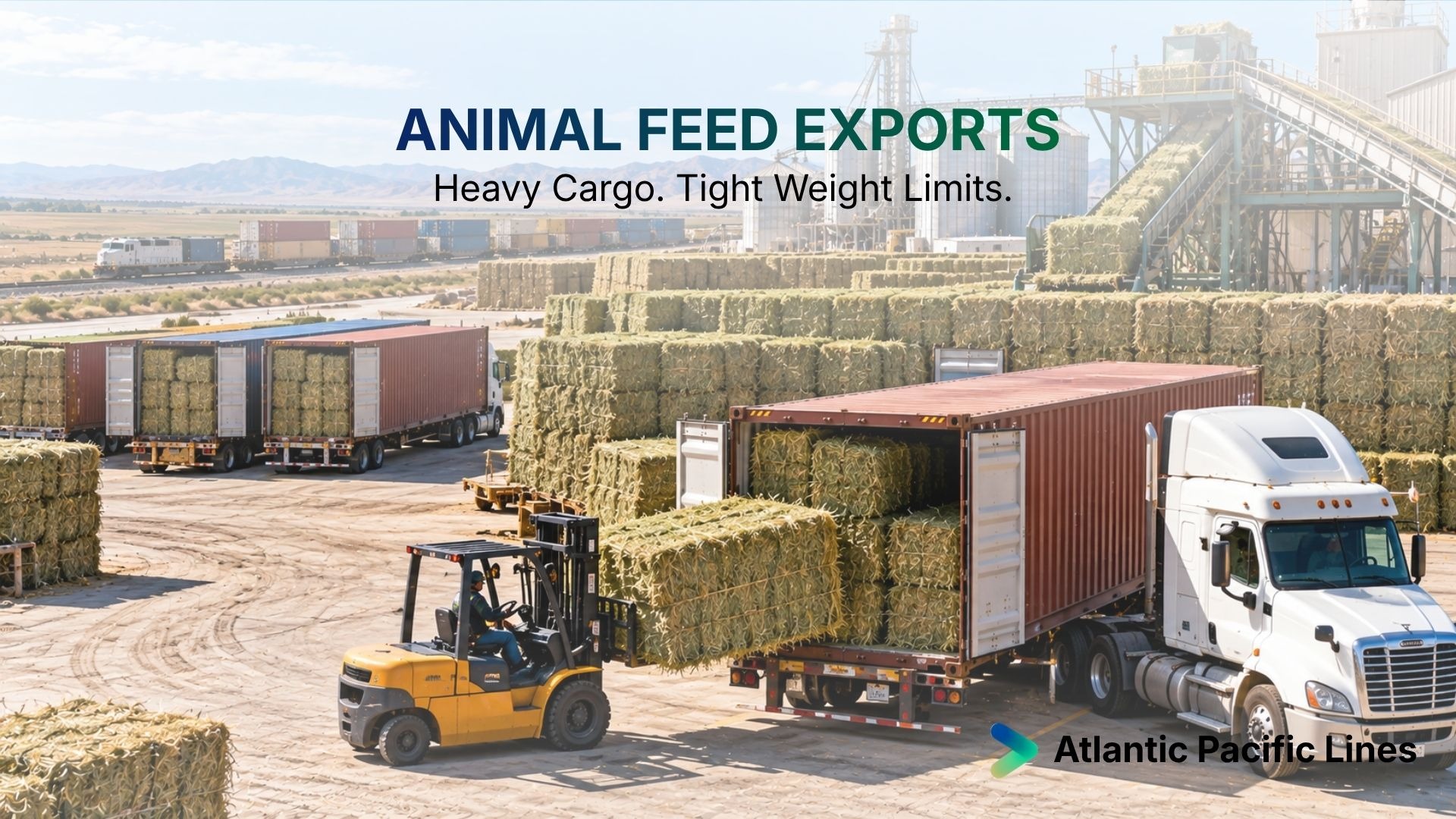
Animal feed and feed ingredients are among the largest containerized agricultural exports from the United States, moving dense, weight-critical cargo such as compressed hay, distillers dried grains, and oilseed meals to feed and livestock markets across Asia, the Middle East, and the Americas. Shipping them well means managing weight and feed-safety discipline while booking ocean capacity correctly, because the cargo is heavy, the equipment is specialized, and the demand is concentrated in a handful of import markets. Atlantic Pacific Lines, an FMC-licensed NVOCC, books against direct service contracts with major ocean carriers, giving exporters contracted space and priority over spot bookings, subject to space and equipment availability, and it handles the inland drayage and transload itself, so the move runs through one company.
For exporters of forage, feed grains, oilseed meals, pet food, and feed additives, the container is the workhorse of the trade. It carries compressed hay to dairy and livestock markets that have no domestic forage, it moves the ethanol and oilseed byproducts that feed animal agriculture across Asia, and it delivers the pet food and specialty ingredients that a growing global middle class demands. This guide explains what feed cargo ships by container, the weight and feed-safety rules that govern it, the concentrated markets that define the trade, the inland origin behind it, and what Atlantic Pacific Lines does differently to keep feed booked, billed, and moving to the animals that depend on it.
What feed cargo moves by container
The feed and ingredients trade spans several distinct cargoes, each with its own handling. Forage, primarily hay and alfalfa, is compressed into dense bales and loaded into dry containers for markets that cannot grow their own, and the United States is one of the world's largest forage exporters. Distillers dried grains, the protein-rich byproduct of ethanol production, is one of the single largest containerized agricultural commodities by volume, moving in bulk-lined or bagged containers to feed markets across Asia. Oilseed meals, pet food, feed additives, premixes, and amino acids fill out the trade, each a container cargo in its own right.
Recent trade shows both the scale and the volatility of the trade. United States hay exports ran at roughly 2.7 million metric tons in a recent year, with alfalfa making up the larger share, though volumes have softened on trade disputes and currency pressure in key markets. Distillers dried grains, by contrast, have grown strongly, running above 5 million metric tons in containerized form and rising sharply to Asian markets such as South Korea. The trade is large, genuinely global, and sensitive to the trade and currency conditions in its concentrated set of buyers, which is part of why capacity and flexibility matter so much to feed exporters.
| Feed product | How it ships | Primary export markets |
|---|---|---|
| Hay and alfalfa (forage) | Double-compressed bales in dry containers | Japan, China, South Korea, Saudi Arabia, Taiwan, and the UAE |
| Distillers dried grains (DDGS) | Bulk-lined or bagged dry containers | Southeast Asia, South Korea, Mexico, and other Asian feed markets |
| Soybean meal and oilseed meals | Bulk-lined or bagged dry containers | Asia, Latin America, and the Middle East |
| Pet food and petfood ingredients | Cartoned or palletized dry containers | Asia, the Middle East, and Latin America |
| Feed additives, premixes, and amino acids | Palletized or drummed dry containers | Global feed-manufacturing markets |
The common thread across these cargoes is density. Feed products are heavy, they pack tightly, and they reach their weight limit well before they fill the container, which puts weight at the center of every feed shipment and makes the feed trade one of the most weight-constrained container trades there is.
Cargo filed correctly, so bookings and billing hold
A problem that quietly costs feed exporters is that many ocean carriers leave agricultural and feed products out of their standard general cargo rates. When a feed commodity is not covered by the rate the booking was made under, the booking can be rejected or the invoice can come back different from the quote, and either outcome delays the shipment or erodes the margin. Feed cargo is specialized and priced differently enough that booking it as ordinary general cargo is a recurring risk, not a rare one.
Atlantic Pacific Lines addresses this at the source by holding agricultural and feed commodity programs with multiple major ocean carriers, so feed cargo is booked under the correct commodity and billed correctly from the start. For an exporter, that means fewer rejected bookings, fewer post-shipment billing surprises, and a booking that holds, which on a thin-margin, high-volume trade like feed is often worth more than a marginally lower rate that does not survive contact with the carrier's rate rules.
Weight is the defining constraint on feed cargo
Compressed hay, meals, and feed grains are among the densest cargoes that move in a dry container, and that makes weight the constraint that governs the feed trade. A container of double-compressed forage or oilseed meal reaches its legal payload limit with the box far from full, and the binding figure is frequently not the container rating but the road weight rule on the drayage leg and the rail ramp overweight threshold on the inland move, which are stricter and vary by corridor. Loading to the container's volume when the cargo is this dense produces a box that cannot legally travel by road or rail, which strands the cargo at the worst moment.
This is why verified gross mass, the VGM required under the SOLAS convention, is central to feed shipping rather than a formality. The exporter must declare an accurate verified gross mass before the container loads, and because feed cargo sits so close to the limit, Atlantic Pacific Lines plans every load against the road weight limits, the rail ramp overweight thresholds, and the carrier payload limits before the container is booked, so the load is planned to the tightest rule in the whole chain. Forage exporters in particular push compression technology precisely to fit more weight legally into each box, and getting the weight right before booking is the difference between a container that sails and one that is stripped and reworked at a cost that can erase the margin on the shipment.
Longer free time and all-in pricing
Two further parts of the Atlantic Pacific Lines program matter directly to a feed exporter's landed cost. The first is free time. Free time is the period a container can stay at the terminal, or out with the shipper, without charge. Once it runs out, demurrage applies at the terminal and detention applies to the equipment, and both clocks start quickly on standard bookings, which bites on a trade where cargo is staged at compression plants and inland ramps. The programs Atlantic Pacific Lines holds with its ocean carrier partners include extended free time at origin and destination, depending on the carrier and the lane, which gives feed cargo more room before those charges begin.
The second is pricing that is quick and complete. Atlantic Pacific Lines publishes monthly rate sheets on its regular lanes, turns around fast quotes on new lanes, and prices door to destination with inland trucking included, so a feed exporter sees one all-in number rather than assembling the ocean, the drayage, and the inland legs separately. For a dense, inland-origin trade where the trucking is a large part of the cost, an all-in rate that already contains the inland leg is far easier to plan and to compare against the thin margins feed runs on.
Exporting feed or forage this season? Send Atlantic Pacific Lines your top lanes and get all-in rates back quickly.
Feed safety, fumigation, and the paperwork that clears the cargo
Feed and feed ingredients carry safety and sanitary obligations that govern how the cargo is handled and documented, and the requirements come from the destination as much as the origin. Importing countries commonly require phytosanitary certificates, fumigation, and feed-safety or veterinary documentation before feed cargo can clear, and forage in particular faces strict pest and weed-seed controls because importers guard against introducing foreign plants and pests. A container that arrives without the documentation the destination requires, or that fails an inspection, can be held, fumigated at cost, or rejected outright.
The container preparation follows from the cargo. Bulk-loaded meals and grains travel in lined containers that keep the feed off the walls and floor and preserve its condition, while baled forage and bagged or palletized ingredients need a clean, dry box and proper securing so the dense cargo does not shift. Because feed products are moisture-sensitive and a wet container can spoil an entire load or breed mold that triggers rejection, container inspection for cleanliness and dryness is a real step, not a formality. The exporter who plans the certificates, the fumigation, and the container preparation alongside the booking keeps feed cargo moving cleanly through destination controls.
A concentrated set of markets, and why flexibility matters
The feed trade is defined by a small number of large import markets, which gives it a concentration that shapes capacity planning. Forage demand centers on the dairy and livestock economies of East Asia and the Middle East: Japan, China, South Korea, Taiwan, Saudi Arabia, and the United Arab Emirates together take the bulk of United States hay and alfalfa, with the lead shifting between them year to year as trade conditions and currencies move. Distillers dried grains flow heavily to Southeast Asia, South Korea, and Mexico, and the other ingredients follow the world's feed-manufacturing centers.
This concentration cuts two ways for an exporter. It means the trade lanes that matter are well-defined and well-served, which supports contracted space on the routes feed actually travels, many of them the transpacific export lanes to Asia that carry so much United States agricultural cargo. But it also means a trade dispute, a tariff, or a currency swing in a single destination can move large volumes quickly, as recent declines in forage shipments to some markets show, so a feed exporter benefits from the flexibility to shift between destinations and gateways as demand moves. Contracted space that spans the lanes a feed program uses, rather than a single loop, is what preserves that flexibility when a market turns.
The inland origin behind feed exports
Like all agricultural exports, feed cargo begins inland. Forage originates in the growing regions of the West and the Plains, while distillers dried grains and oilseed meals come from the ethanol and crushing plants of the Midwest and the Ohio Valley, not from the coast. A containerized feed export is therefore first an inland move: the empty container is positioned to a compression facility, an elevator, or a plant, stuffed at origin, and railed or drayed to the port, or the cargo is moved to a port-area facility and transloaded. The inland leg carries much of the cost and the weight constraint, and planning it is inseparable from the ocean booking.
The inland model turns on the cargo and the equipment picture. Forage compression plants load containers at origin and rail them to the port; bulk meals and grains may be stuffed at the plant or transloaded nearer the coast. Transload and warehousing near the port supports the port-area model, and the drayage and inland coordination that connect the origin plant to the terminal are handled by Atlantic Pacific Lines itself, so the inland leg and the ocean booking sit with one company. Knowing the origin and the inland path is the starting point for pricing and planning a feed export, because the inland leg is where the weight limit bites and where equipment can fail to appear.
How contracted vessel space ties the feed export together
All of the weight and feed-safety discipline depends on the cargo sailing, and the export lanes that carry feed tighten in peak season like every ocean trade, with the added pressure that feed moves heavy and needs sound, dry equipment. Atlantic Pacific Lines books against direct service contracts with major ocean carriers across its vessel space allocation on major trade lanes and gives exporters contracted space and priority over spot bookings, with the equipment planned into the booking, so contracted cargo is protected ahead of spot cargo when space is short. When a sailing is cut by blank sailings and withdrawn capacity, contracted feed cargo holds its place while spot cargo rolls.
Joining the contracted space to the inland origin and the weight discipline is the point. Space that is held but fed by an inland leg with no container, or filled with a box loaded past the road limit, does not move the cargo. The exporters who ship feed cleanly book under the correct commodity, plan the inland positioning and the weight together, and build each move backward from the port cutoff dates so the heavy container meets its vessel. Because Atlantic Pacific Lines handles the drayage, the transload, and the ocean booking itself, the whole move from inland plant to overseas buyer runs through one company. For the broader food and commodity side of the trade, our guide to shipping agricultural commodities and foodstuffs covers the grains, pulses, and perishables that travel the same lanes.
How to ship animal feed and ingredients smoothly
A short set of habits keeps feed cargo moving to market.
- Book under the correct commodity from the start, since many carriers exclude feed products from general cargo rates, which causes rejected bookings and billing disputes.
- Plan the payload to the tightest weight limit in the chain, the road rule, the rail ramp threshold, or the carrier payload limit, and declare an accurate verified gross mass, since feed cargo loads to weight long before it fills the box.
- Arrange phytosanitary, fumigation, and feed-safety documentation before loading, since forage and feed ingredients face strict destination pest and sanitary controls.
- Inspect and prepare the container for cleanliness and dryness, and line bulk meals and grains, since feed is moisture-sensitive and a wet or dirty box can spoil the load.
- Secure contracted space across the lanes a feed program uses rather than a single loop, preserving the flexibility to shift between concentrated markets when trade or currency conditions move.
- Keep the inland move, from the compression plant, elevator, or crushing facility, with the same company that books the ocean leg, so the heavy cargo moves as one plan.
Ready to move your feed exports?
Atlantic Pacific Lines books feed and ingredient exports under the correct commodity with contracted carrier space, plans dense loads against road, rail, and carrier limits before booking, and prices the move door to destination with inland trucking included. Send us your top lanes and Atlantic Pacific Lines will come back with all-in rates within 24 hours.