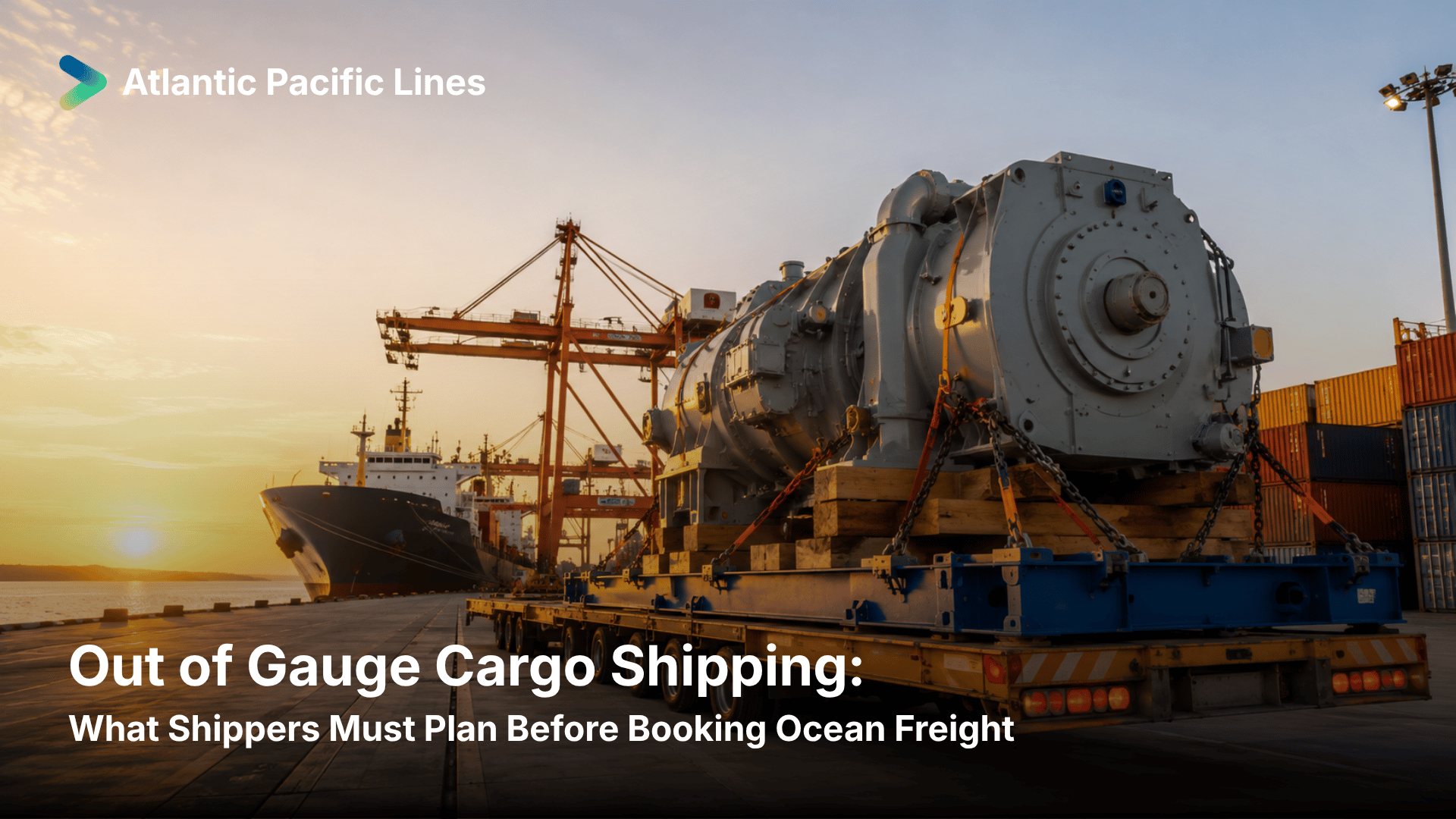
Out-of-gauge cargo needs planning before the shipment is booked. Once oversized cargo reaches the port, the room for correction becomes limited. If the dimensions are wrong, the lifting method is unclear, the inland route is not checked, or the terminal has not approved the handling plan, the shipment can face delays before it even reaches the vessel.
For shippers moving machinery, industrial equipment, large vehicles, construction units, steel structures, plant components, or any cargo that cannot fit inside a standard container, the booking process must start with feasibility. The question is not only whether ocean freight space is available. The real question is whether the cargo can move safely, legally, and predictably from origin to destination.
Out-of-gauge cargo shipping requires coordination across equipment selection, inland transport, port handling, carrier approval, documentation, customs, insurance, and milestone visibility. A small planning gap can lead to rejected bookings, revised costs, missed vessel cutoffs, terminal storage charges, or final delivery complications.
Atlantic Pacific Lines supports this type of movement through ocean freight, land, and intermodal coordination, customs support, cargo insurance, documentation guidance, and shipment visibility. For complex cargo, connected planning is what protects the shipment before the freight actually moves.
What Is Out of Gauge Cargo?
Out-of-gauge cargo refers to freight that exceeds the size or weight limits of a standard shipping container. It may be too tall, too wide, too long, too heavy, or shaped in a way that prevents normal container loading.
This type of cargo often includes heavy machinery, industrial equipment, oversized vehicles, project cargo, energy equipment, construction machinery, large fabricated components, and commercial cargo that needs special handling.
The cargo may move on a flat rack container, inside an open top container, by Ro Ro vessel, as break bulk cargo, or through a heavy haul and ocean freight combination. The right method depends on the cargo profile, route, port capability, handling requirements, and delivery timeline.
The mistake many shippers make is treating out-of-gauge cargo as a larger version of regular freight. It is not. It needs a different planning process because the shipment depends on technical accuracy, carrier approval, equipment availability, terminal readiness, and inland route feasibility.
Why Planning Must Start Before Booking
A standard container shipment can often be quoted and booked with relatively predictable information. Out-of-gauge cargo is different. The freight partner needs to understand the cargo in detail before offering a reliable plan.
Dimensions must be final. Weight must be accurate. The packed cargo profile must be clear. Lifting points should be known. The origin and destination access must be practical. The terminal must be able to handle the cargo. The carrier must approve the equipment and stowage requirements.
If these checks happen after booking, the shipment becomes vulnerable. The rate may change. The carrier may reject the cargo. The cargo may miss the planned sailing. Inland transport may require permits that were not considered. The terminal may refuse entry without proper handling confirmation.
For importers, exporters, manufacturers, and procurement teams, this can affect more than freight cost. It can affect project timelines, customer commitments, installation schedules, and landed cost control.
A reliable out-of-gauge shipment starts with one question:
Can this cargo actually move through every stage of the route without creating avoidable risk?
The First Priority Is Accurate Cargo Data
Out-of-gauge planning begins with the cargo profile. Estimated dimensions are one of the biggest reasons oversized shipments run into trouble.
The shipper should confirm the final cargo size exactly as it will move. That means the packed, crated, mounted, wrapped, or skid-based dimensions should be shared, not only the product dimensions from a catalogue or invoice.
A machine that looks manageable on paper may become out of gauge once its base frame, attachments, protective covering, or transport supports are included. A small difference in width or height can change the equipment type, port handling method, inland permit requirement, or freight rate.
Weight also needs careful review. The total gross weight is important, but weight distribution matters too. A heavy unit with uneven load concentration may need special securing, lifting, or route planning. If the center of gravity is unclear, the cargo can become difficult or unsafe to handle.
For complex equipment, technical drawings and clear photographs are often more useful than a simple description. They help the freight partner understand the cargo shape, lifting points, tie-down areas, and handling limitations before the booking is finalized.
Choosing the Right Shipping Method
There is no single best method for out-of-gauge cargo. The correct option depends on how the cargo is built, how it can be handled, and where it needs to move.
A flat rack container is often used when cargo is too wide or too high for a standard container, but can still be secured safely on a container base. It is commonly used for machinery, industrial components, vehicles, and equipment that need side or top clearance.
An open-top container may be suitable when cargo is too tall for a standard container but can still fit within the base and side walls. It allows top loading by crane and can be useful for certain machinery or equipment that cannot be loaded through standard container doors.
Ro Ro shipping may work when the cargo can roll, drive, or be towed onto the vessel. This can be practical for vehicles, heavy equipment, trucks, trailers, and wheeled machinery, provided the route and port support Ro-Ro handling.
Break bulk may be required when the cargo cannot be containerized or moved safely through Ro-Ro. This option is usually more complex because the cargo is handled directly and may require vessel-specific loading, lifting, securing, and discharge planning.
The right choice should not be made only on the freight rate. It should be based on execution risk, availability, cargo safety, route reliability, and total movement cost.
| Cargo Situation | Possible Shipping Method | Planning Focus |
|---|---|---|
| Too wide or too high for a standard container | Flat rack | Securing, lashing, carrier approval, and inland route |
| Too tall, but still container base compatible | Open top | Crane loading, height exposure, and terminal handling |
| Rolling or towable equipment | Ro Ro | Route availability, port handling, and cargo condition |
| Too large or unsuitable for container movement | Break bulk | Lifting plan, vessel handling, weather exposure |
| Heavy or oversized inland movement | Heavy haul plus ocean freight | Permits, route clearance, pickup, and delivery access |
This decision should happen before the booking request, not after the cargo is ready for pickup.
Inland Movement Can Decide Whether the Shipment Works
For out-of-gauge cargo, inland transport is often the most underestimated part of the shipment. Ocean freight may be available, but the cargo still has to reach the port safely and legally.
A factory, warehouse, yard, auction site, project location, or supplier facility may not have the loading access needed for oversized cargo. The road route may have bridge limits, low clearances, tight turns, weight restrictions, or permit requirements. Some moves may require escort vehicles, special chassis, heavy haul trailers, cranes, or restricted travel windows.
This is why inland planning must be connected to ocean planning. A freight plan that only confirms vessel space is incomplete. The shipment must be reviewed from the pickup location to the port gate and from the destination port to the final delivery.
Atlantic Pacific Lines' logistics structure is relevant here because out of gauge shipments often need more than ocean freight. They need coordination between land movement, port handling, customs readiness, and final delivery. When these stages are planned together, shippers have a better chance of avoiding last minute disruption.
Port and Carrier Approval Should Come Early
Out of gauge cargo usually requires carrier review before the booking is confirmed. The carrier may need dimensions, weight, cargo drawings, photos, lifting details, stowage requirements, and confirmation of the equipment type.
The port or terminal may also have its own requirements. Some terminals need advance approval for oversized cargo. Some may restrict delivery times or require specific handling equipment. Others may have rules around storage, loading windows, gate appointments, or cargo presentation.
This is where shippers should be careful. A quoted rate does not always mean the cargo has been operationally accepted. The rate may be based on initial information, while final acceptance depends on technical review.
Early carrier and terminal approval helps protect the shipment from booking rejection, equipment mismatch, missed cutoff, and unexpected terminal charges. It also gives the shipper time to adjust the plan before the cargo is already in motion.
For complex shipments, a freight partner with NVOCC capability and carrier relationships can help turn a general shipping request into a workable execution plan.
Loading and Securing Cannot Be Treated as a Final Detail
Out of gauge cargo must be handled with a clear loading and securing plan. The cargo may need crane loading, forklift handling, rigging support, blocking, bracing, lashing, or a cargo survey.
The freight partner needs to understand how the cargo can be lifted and where it can be secured. If the lifting points are weak, hidden, missing, or unknown, the cargo may need additional preparation. If the cargo has uneven weight distribution, the securing plan must account for that. If the cargo is exposed on a flat rack or moved as break bulk, weather exposure and movement during transit must also be considered.
The goal is not only to get the cargo onto the vessel. The goal is to make sure it remains stable and protected throughout the movement.
This is especially important for machinery and industrial equipment because damage can be expensive, difficult to repair, and disruptive to the final project schedule.
Documentation Must Match the Cargo Reality
Out of gauge cargo creates documentation risk when the paperwork does not match the actual cargo.
The commercial invoice, packing list, bill of lading instructions, customs information, cargo description, weight, dimensions, and declared value should all be aligned. If the cargo is crated, dismantled, refurbished, used, rebuilt, hazardous, or subject to any special regulation, that information should be handled before the shipment moves.
For U.S. importers and exporters, customs readiness is not only about having documents available. It is about making sure the documents are accurate enough to support clearance without delay.
Atlantic Pacific Lines includes customs and compliance support within its service positioning, which is valuable for out of gauge cargo because documentation issues become harder to resolve once oversized freight is already at the port or in transit.
Cargo Insurance Should Be Reviewed Before Movement
Out of gauge cargo often carries higher financial exposure than standard container freight. Machinery, vehicles, industrial equipment, and project cargo can be high value, difficult to replace, and time sensitive.
Cargo insurance should be reviewed before booking or pickup. The shipper should understand whether the cargo is covered across the full movement, including inland transport, terminal handling, ocean transit, discharge, and final delivery. The coverage should reflect the cargo value, condition, handling risk, and route.
Insurance does not replace proper planning, but it helps protect the shipper from financial exposure when risk cannot be fully eliminated.
For oversized cargo, this review should happen early because the shipment may involve multiple handling points and a higher probability of special movement conditions.
Visibility Should Cover the Full Cargo Journey
Tracking the vessel is not enough for out of gauge cargo. Shippers need visibility across the key operational milestones that affect the shipment.
The important questions are practical. Has the cargo been picked up? Has it reached the port? Has the terminal accepted it? Has the carrier loaded it on the planned vessel? Has customs documentation been processed correctly? Are there schedule changes? Is the destination delivery plan still aligned?
For complex cargo, visibility is not only about knowing where the shipment is. It is about identifying exceptions early enough to act.
Atlantic Pacific Lines' digital visibility and dedicated support model fits this requirement because out of gauge shipments need proactive coordination across pickup, port, vessel, customs, and delivery stages.
Total Cost Is More Than the Ocean Rate
The ocean freight rate is only one part of the cost picture.
Out of gauge cargo may involve heavy haul trucking, special equipment, permits, escorts, crane handling, lashing, terminal handling, cargo survey, storage, customs clearance, insurance, destination handling, and final delivery.
A low ocean rate can become expensive if the inland movement is not feasible, if the port handling charges are not reviewed, or if the cargo misses the planned sailing due to incomplete preparation.
Shippers should evaluate the full movement cost before approving the route. This helps compare options more accurately and prevents the booking from becoming a cost surprise later.
The best freight plan is not always the cheapest first quote. It is the plan that gives the shipper the strongest control over cost, timing, cargo safety, and delivery certainty.
A Practical Pre Booking Review
Before confirming an out of gauge shipment, shippers should make sure four areas are clear.
First, the cargo profile must be accurate. This includes final dimensions, weight, photographs, drawings, lifting points, cargo value, and any handling restrictions.
Second, the movement plan must be feasible. The origin, inland route, port, vessel, destination terminal, and final delivery point should all be checked before the cargo moves.
Third, the commercial and compliance details must be ready. Documentation, customs information, insurance, and carrier requirements should match the actual cargo and route.
Fourth, visibility and responsibility must be defined. Shippers should know who is monitoring each milestone and who will act if the shipment faces an exception.
This pre booking review keeps the blog practical without turning it into a long list. It also reflects how out of gauge cargo should be managed in real operations.
How Atlantic Pacific Lines Supports Out of Gauge Cargo Planning
Out of gauge cargo requires a freight partner that can think across the full shipment. The work does not stop at finding vessel space.
Atlantic Pacific Lines supports shippers through ocean freight solutions, land and intermodal coordination, customs and documentation support, cargo insurance options, digital visibility, and dedicated personnel. This matters because oversized cargo often moves through several risk points before it reaches the final destination.
The value is in connecting the stages. Cargo details are reviewed before booking. The right mode and equipment are evaluated. Inland feasibility is checked alongside ocean freight. Documentation and customs planning are addressed early. Visibility is maintained across movement milestones.
For shippers, this creates a more controlled process. Instead of reacting to problems at the port, they can identify risks earlier and move with a clearer execution plan.
Final Thoughts
Out-of-gauge cargo shipping depends on planning accuracy. The cargo must be measured correctly, matched to the right equipment or shipping method, approved by the carrier, accepted by the terminal, moved through a feasible inland route, documented properly, insured appropriately, and monitored across each milestone.
The wrong approach is to request a rate first and solve the technical details later. That creates risk.
The better approach is to confirm whether the cargo can move safely and predictably before the booking is finalized.
For shippers moving oversized machinery, industrial equipment, heavy vehicles, or complex commercial cargo, Atlantic Pacific Lines provides the coordination needed to connect ocean freight with inland movement, customs readiness, cargo insurance, and shipment visibility.
Out of gauge cargo is not a standard shipment with larger dimensions. It is a shipment that needs control before it moves.