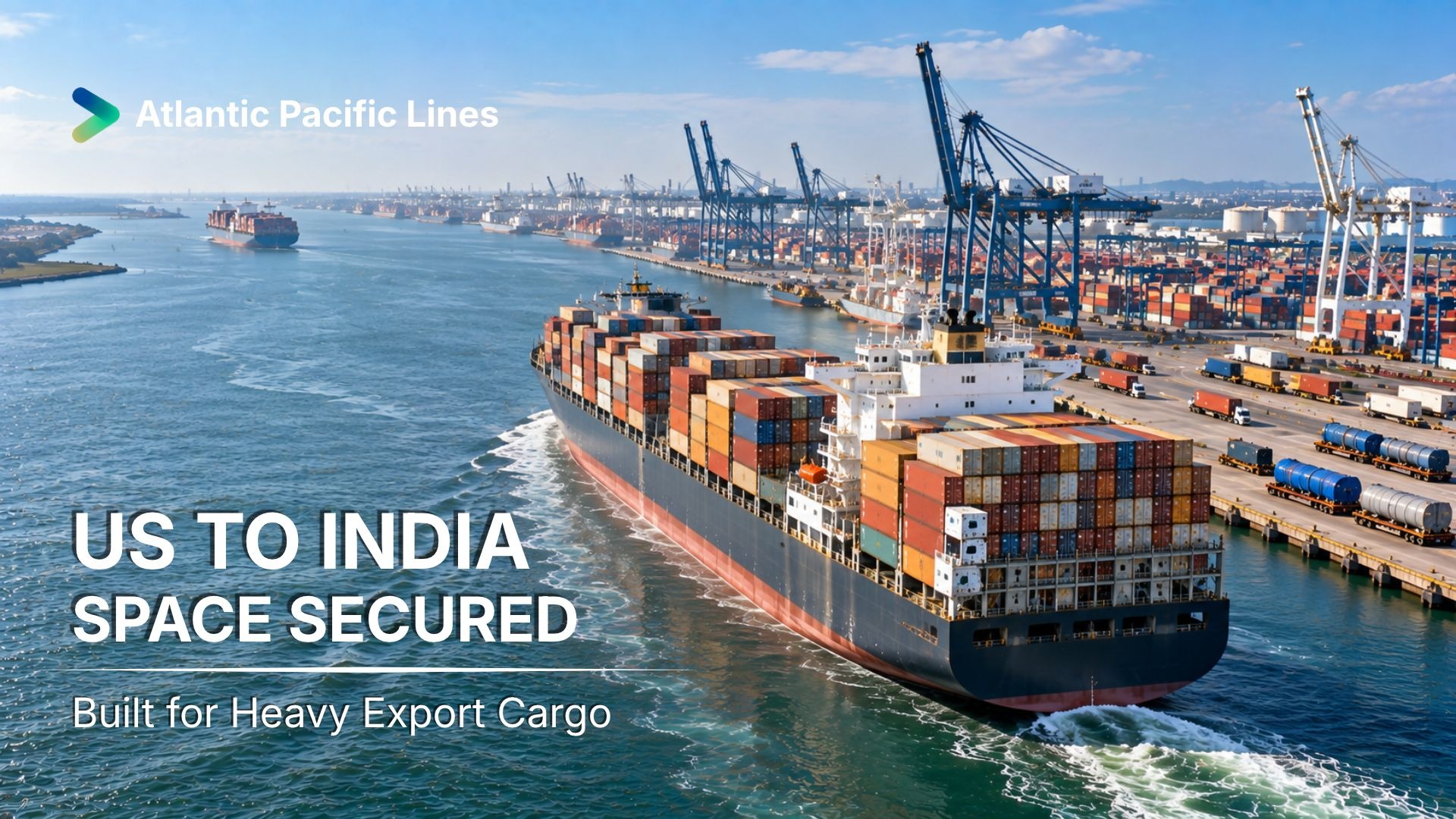
United States exporters secure vessel space to India by committing allocation early on a lane where almost every service tranships through an intermediate hub, which makes the connection as important to protect as the ocean leg. Direct-equivalent transit runs around 30 to 45 days or more from the West Coast and 28 to 40 days or more from the East Coast and Gulf, with the cargo concentrated in heavy and industrial goods. Atlantic Pacific Lines, an FMC-licensed NVOCC, commits guaranteed vessel space allocation, booking, and shipping capacity from the United States to India.
The United States to India export lane is one of the most misunderstood major trades, because it does not behave like the transpacific that most exporters know. There is very little direct service; almost everything tranships through a hub in Asia, the Middle East, or the Mediterranean, which means the journey has two ocean legs and a connection in between, and the connection is where cargo is most often delayed or rolled. This guide covers how the lane is structured, the transhipment reality that defines it, the verified transit expectations by coast, the heavy and industrial cargo that dominates it, the equipment and documentation discipline it demands, and how committed allocation holds an export program together across two legs and a hub.
What the United States to India export lane is
The lane carries United States exports to the Indian market, and its cargo mix is distinctive. Where the eastbound transpacific is dominated by finished consumer goods, the westbound flow to India is heavy and industrial: machinery and mechanical equipment, scrap and recovered materials such as metal and paper, chemicals, plastics and resins, agricultural products including almonds, pulses, and cotton, stone and quartz, and project and industrial cargo. Much of this is dense, weight-critical freight that runs close to container weight limits, which shapes both the equipment and the booking. The exporters range from large industrial and agricultural shippers to manufacturers serving India's growing economy, and the common thread is cargo where value and weight both matter.
On the Indian side, the cargo discharges through a small number of gateways. Nhava Sheva, formally Jawaharlal Nehru Port, near Mumbai, and Mundra in Gujarat, now among India's largest container ports, handle the bulk of the volume on the west coast of India, serving western, central, and much of northern India, the latter often through inland container depots. Chennai on the east coast serves southern and eastern India. Which Indian port a shipment targets follows the final destination within India, and it interacts with the routing, because the transhipment hub and the Indian discharge port together determine the real transit.
| Routing | Typical transit | Notes |
|---|---|---|
| US West Coast to India | Around 30 to 45 days or more port to port | From Los Angeles, Long Beach, Oakland, and Seattle, almost always transhipping through an Asian or Middle East hub |
| US East Coast and Gulf to India | Around 28 to 40 days or more port to port | From New York and New Jersey, Savannah, Norfolk, Charleston, and Houston, routed via the Mediterranean, the Suez Canal, or a Middle East hub |
| Via the Cape of Good Hope | Longer than the Suez routing when in effect | When Red Sea conditions divert services around the Cape, East Coast to India transits lengthen materially |
The transhipment reality that defines the lane
The single most important thing to understand about shipping from the United States to India is that almost no service runs direct. The trade volume does not support the frequency of direct sailings that the transpacific enjoys, so nearly every container tranships: it sails on one vessel to a hub, is discharged, waits, and loads onto a second vessel for the run to India. The hubs vary by routing, and they sit in Asia, the Middle East, or the Mediterranean depending on which coast the cargo leaves and which service it takes. This structure is why the lane's transit times carry more variability than a direct trade, because the connection at the hub can go smoothly or add days.
The transhipment structure has a direct consequence for capacity, and it is the same lesson that governs every connected routing: a booking that secures space only on the first leg is a booking with an open end. If the second vessel, out of the hub to India, is full, the container waits at the hub regardless of how cleanly it sailed to get there. This is the connected-routing risk covered in our guide to guaranteed vessel space from Vietnam and Southeast Asia, applied in the opposite direction, and it is why committed space on this lane has to cover the whole routing, both ocean legs and the connection, not just the departure from the United States.
Transit times from the United States to India
Because the lane tranships, transit is best read as a band rather than a single figure. From the United States West Coast, sailing from Los Angeles, Long Beach, Oakland, or Seattle, port-to-port transit to the Indian west coast ports runs around 30 to 45 days or more, routed across the Pacific and through an Asian or Middle East hub. From the East Coast and Gulf, sailing from New York and New Jersey, Savannah, Norfolk, Charleston, or Houston, transit to India runs around 28 to 40 days or more, routed across the Atlantic and through the Mediterranean, the Suez Canal, or a Middle East hub, and the East Coast can be shorter to the Indian west coast than the long Pacific routing suggests.
One standing conditionality lengthens the East Coast picture. When security conditions in the Red Sea divert services around the Cape of Good Hope instead of through the Suez Canal, East Coast to India transits stretch materially beyond the baseline. As on every lane in this cluster, these are healthy-conditions figures to plan against at the longer end, and the transhipment connection, port congestion, and canal conditions all push the real number higher. Less than container load cargo adds consolidation time on top. The honest planning posture is to build the export program around the conservative end of the band and to treat the hub connection as a place where time can be lost.
Equipment, weight, and documentation on a heavy lane
The industrial character of the cargo makes equipment and weight discipline central to this lane in a way they are not everywhere. Scrap, stone, machinery, and resins are dense, and many shipments run close to the maximum permitted container weight, which means every container needs its verified gross mass documented accurately before it loads, with little margin for error. Overweight or mis-declared containers are refused, and on a transhipment lane a refusal at origin cascades into a missed connection downstream. Equipment availability matters too, because heavy cargo sometimes needs specific container types or reinforced units, which have to be committed alongside the space rather than assumed.
Documentation carries the same weight, because the lane's length and its transhipment mean errors are expensive to fix once the cargo is moving. Building each booking backward from the port cutoffs, filing accurate paperwork early, and getting the commodity and weight details right the first time keeps a container from being the one left behind at origin or stranded at the hub. On a lane where a missed connection can add a week or more, the discipline that prevents a documentation failure is worth far more than it appears.
How committed allocation holds a two-leg lane
Atlantic Pacific Lines books against direct service contracts with major ocean carriers and commits United States to India space with the whole routing inside the commitment: the first ocean leg, the connection at the hub, and the second leg to the Indian discharge port, with the equipment planned in. Because the commitment spans the connection, an exporter's cargo holds its onward vessel out of the hub rather than competing for whatever space remains there, which is the difference between a booking that reaches India on schedule and one that sits at a transhipment port. On full container load export programs, that end-to-end shape, with the weight and equipment discipline built in, is what lets a heavy industrial export program hold its delivery dates across two legs and a hub.
The lane also runs in the other direction, and the two are worth planning together. The inbound flow from India to the United States, its ports, and its own transit realities are covered in our guide to guaranteed vessel space between the United States and India, and an exporter who also imports on the lane gains from planning both directions on shared services and a shared equipment cycle. The westbound export twin of this discipline on the transpacific is set out in our guide to guaranteed vessel space from the United States to China, and the same principle holds here: committed space is what turns a routing on paper into cargo that actually arrives.
How to lock United States to India export space
A short set of disciplines fits this lane's specific shape.
- Commit allocation across the whole routing, both ocean legs and the hub connection, since a booking that covers only the departure from the United States has an open end at the transhipment port.
- Choose the Indian discharge port by the cargo's final destination within India, matching Nhava Sheva or Mundra for western and northern India and Chennai for the south.
- Plan against the longer end of the transit band, adding buffer for the connection, congestion, and, on East Coast routings, canal conditions.
- Get weight and verified gross mass exactly right, since dense industrial cargo runs close to the limits and a refusal at origin cascades into a missed connection.
- Commit the equipment with the space, especially where heavy or specialized cargo needs specific container types.
- Build each booking backward from the cutoffs and file documentation early, because errors are expensive to fix once the cargo is moving on a long, transhipping lane.
Exporters who plan this way keep their cargo moving across a lane that strands those who book only the first leg. It is the basis on which Atlantic Pacific Lines commits guaranteed space from the United States to India, matched to each exporter's gateways, cargo, and Indian destinations.