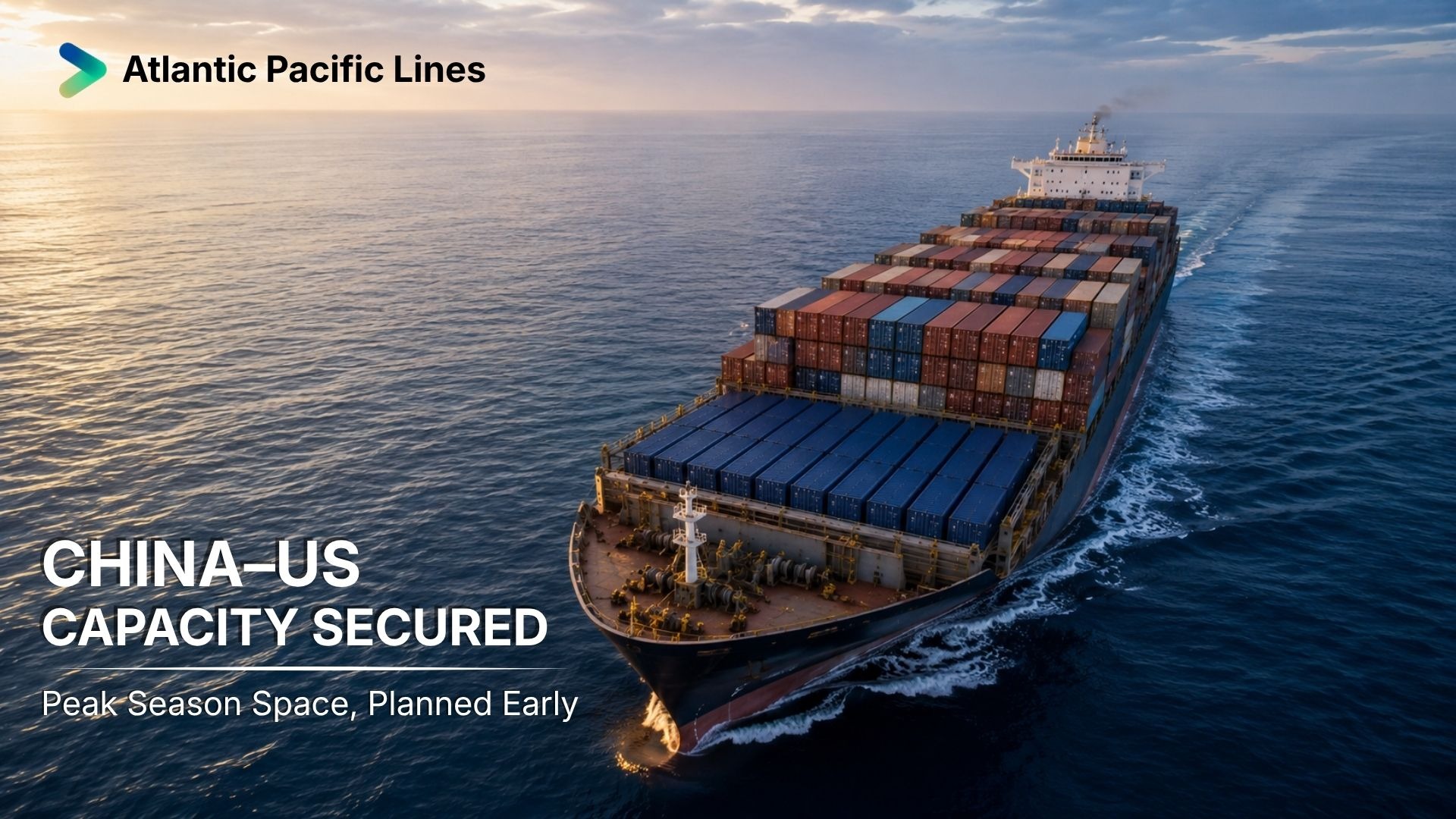
Shippers secure guaranteed vessel space from China to the United States by committing allocation on named transpacific services before peak season begins, rather than booking on the spot market when vessels are already full. Committed slots load ahead of spot cargo when space is rationed. Atlantic Pacific Lines, an FMC-licensed NVOCC, commits guaranteed space and equipment on the China to United States lane across West Coast and all-water East Coast routings.
The China to United States trade is the highest-volume containerized lane in the world, and it is the one where space discipline matters most. When peak season builds, the shippers who planned capacity in advance keep loading, and the shippers who did not compete for whatever is left. This guide covers when transpacific space tightens, how the West Coast and East Coast routings differ, and how committed allocation holds a booking when the market does not.
When transpacific peak season tightens China to United States space
The transpacific runs on a calendar that repeats every year. Factory output restarts after the Lunar New Year period, when plants across China close for one to two weeks and shipping pauses. Volume then builds through the second and third quarters as importers move goods ahead of the Western holiday retail season, which is the traditional peak. Early October brings Golden Week, the national holiday when Chinese factories and some port operations slow again, usually preceded by a rush to ship ahead of the closure. Carriers manage the swings on both sides, adding capacity into the peak and removing sailings during the slack periods that follow the holidays.
Two commercial instruments track this cycle. A general rate increase lifts the base rate across the trade, and a peak season surcharge adds a charge during the busiest months. Both raise the price of spot space without reserving any of it. The annual transpacific service contract cycle, which traditionally renews around the first of May, is where committed space is set for the year ahead, which is why allocation is negotiated before the peak rather than during it.
West Coast or all-water East Coast: how the routing changes your space
China to United States cargo moves on two broad routings, and each has a different space and timing profile.
The West Coast routing runs into Los Angeles, Long Beach, Oakland, and the Seattle and Tacoma gateways. It is the fastest option, typically around two to three weeks from the main China ports, and it carries the heaviest volume, which also makes it the first to tighten in peak season. Much of this cargo transloads at the West Coast and moves inland by rail to hubs such as Chicago, Dallas, and Memphis, so allocation on this routing depends on drayage and transload capacity at destination as much as on the vessel.
The all-water East Coast routing sails through the Panama Canal into New York and New Jersey, Savannah, Norfolk, Charleston, and Houston. It is slower, often four to five weeks or more, but it delivers directly to East Coast and Gulf markets without an inland rail leg, and it can relieve pressure when West Coast capacity and inland networks are stretched. Choosing between the two is partly a cost and transit decision and partly a capacity decision, because spreading volume across both routings is itself a way to protect space.
| Routing | Typical transit from China | Delivers to | Best suited to |
|---|---|---|---|
| West Coast port direct | About two to three weeks | Los Angeles, Long Beach, Oakland, Seattle, Tacoma | West Coast distribution and the fastest ocean transit |
| West Coast plus inland rail | Ocean transit plus several days by rail | Inland hubs such as Chicago, Dallas, Memphis | Inland destinations that need West Coast ocean speed |
| All-water East Coast | Often four to five weeks or more | New York and New Jersey, Savannah, Norfolk, Charleston, Houston | East Coast and Gulf markets, and relieving West Coast pressure |
How guaranteed allocation protects a China to United States booking
When a transpacific vessel is oversubscribed, space is not sold to the highest bidder at the gate. Committed cargo loads first, and available space is pro-rated among contract shippers before anything is left for the spot market. A booking without a commitment is the first to roll to a later sailing, which on this lane can mean a delay of a week or more and a scramble for the next available slot.
Allocation changes that position. A shipper holding committed slots on named transpacific services has space reserved before the vessel fills, priced under contract and insulated from the surcharges that ration spot capacity. Atlantic Pacific Lines holds allocation with carriers on the China to United States lane and commits that space, with equipment, to its customers, which is what allows a booking to hold through the weeks when spot space disappears. On full container load programs in particular, that certainty is the difference between a delivery that lands on schedule and one that waits.
Equipment and cutoffs on the China to United States lane
Space is only half of a China to United States booking. The other half is equipment and timing at origin. Container availability at the load ports moves with the cycle, tightening before the Lunar New Year and Golden Week rushes when everyone is trying to ship at once, and reefer and specialised equipment can be scarce on specific port pairs. A committed allocation that names the equipment and the load port removes much of that risk.
Timing is the other trap. Every booking has to meet the port cutoffs for documentation, the verified gross mass of the container, and physical gate-in, and missing any of them can roll the container to the next sailing regardless of the space held. In peak season, when terminals are congested and cutoffs are firm, the margin for error narrows. Planning the booking around the cutoffs is as important as planning it around the vessel.
How to lock China to United States space before peak season
Securing transpacific space is a matter of timing and commitment. A few steps make the difference on this lane.
- Set the commitment against the annual transpacific cycle, ahead of the May renewal and well before the third-quarter build, so the space is in place before demand peaks.
- Forecast by load port and by week, since capacity tightens port pair by port pair rather than across the whole trade at once.
- Decide the routing split between West Coast and all-water East Coast, so volume is not exposed to a single set of gateways when they congest.
- Commit equipment with the space, naming the load ports and any reefer or specialised requirements.
- Build the booking around the documentation, verified gross mass, and gate cutoffs, so a held slot is not lost to a missed deadline.
- Consolidate the volume with a carrier-side partner that already holds transpacific allocation, which converts individual bookings into committed space.
Shippers that plan this way keep moving through Golden Week, the peak build, and the congestion that follows. It is the basis on which Atlantic Pacific Lines commits guaranteed space on the China to United States lane, matched to each customer's load ports and volume.