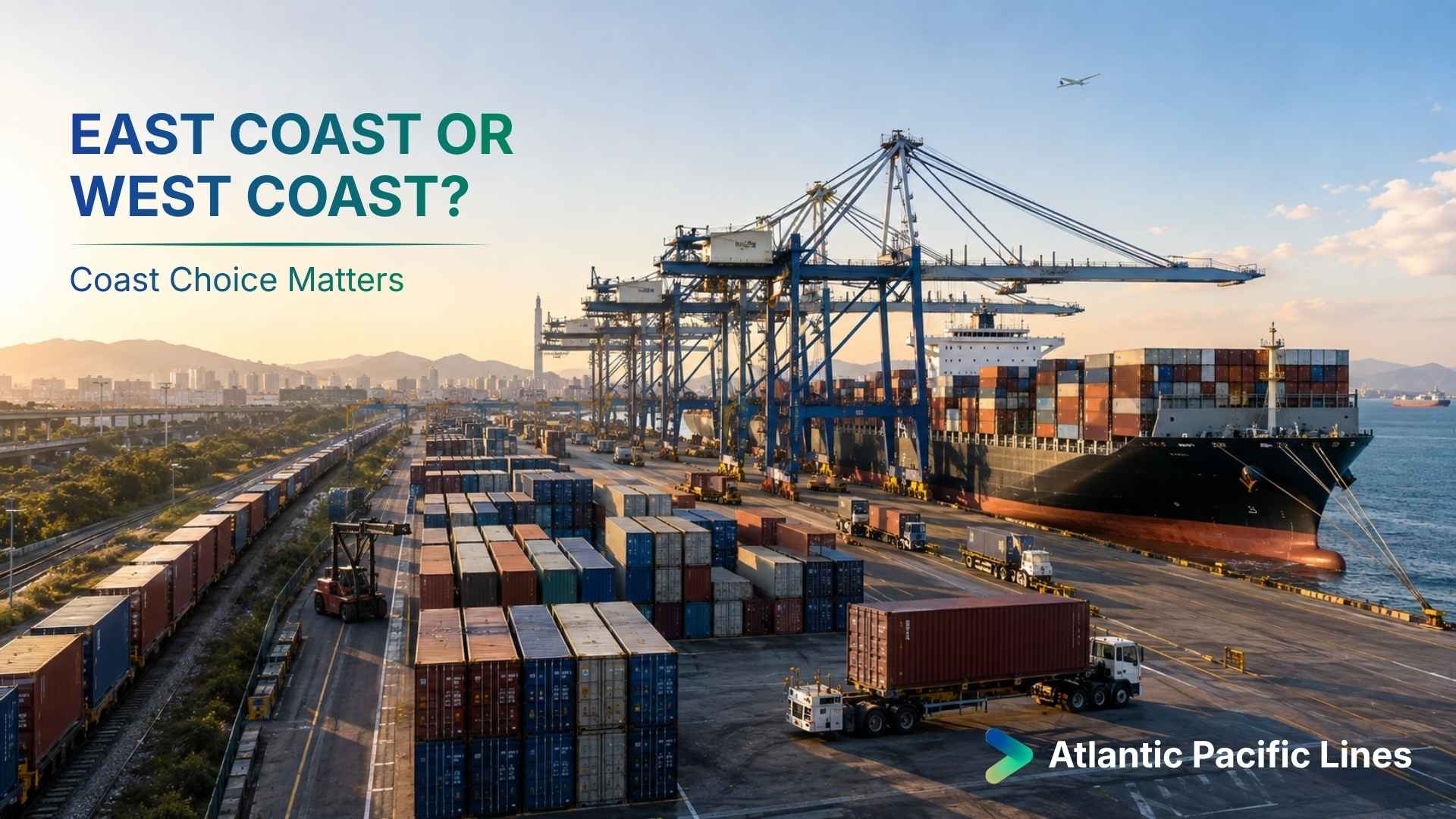
China cargo should route to the United States coast that serves the freight's final destination at the lowest delivered time and cost, not simply the coast with the shortest ocean transit. The West Coast, reached in roughly 14 to 21 days, offers the fastest water and the deepest service choice, and anchors rail moves inland. The East Coast, reached in about 28 to 40 days or more via the Panama Canal, suits cargo whose destination sits in the East and can absorb the longer crossing without an inland leg. Atlantic Pacific Lines, an FMC-licensed NVOCC, commits guaranteed vessel space allocation, booking, and shipping capacity from China to both United States coasts.
The coast decision is one of the most consequential choices an importer makes on the China lane, and one of the most frequently made by habit. The West Coast is the default because it is fastest and busiest, but fastest to the port is not the same as fastest to the door, and the cheapest ocean leg can become the most expensive delivered cost once the inland move is counted. This guide sets out how China cargo reaches each coast, the verified transit math behind the choice, the destination logic that should actually drive it, the different capacity risks each routing carries, and how committed allocation keeps whichever coast a shipper chooses from becoming a bottleneck.
How China cargo reaches each United States coast
The West Coast routing is the shortest and the busiest. Direct services from the main Chinese ports reach Los Angeles and Long Beach, Oakland, and the Pacific Northwest in roughly 14 to 21 days port to port, on the highest sailing frequency and the deepest choice of services on the entire transpacific. For cargo bound for the Western United States, it is the obvious answer, and for cargo bound inland it is the usual first leg of a rail move, the landbridge, that carries the container to the Midwest and sometimes onward to the East.
The East Coast routing is the longer all-water alternative. Services sail from China to New York and New Jersey, Norfolk, Charleston, and Savannah, with Gulf calls on selected loops, commonly taking about 28 to 40 days or more, because the vessel transits the Panama Canal and covers far more distance. What the extra water buys is a single vessel move with no inland leg: the cargo arrives on the coast where it is needed, without the cost, handling, and rail-capacity dependence of a transcontinental move. On a lane where several Chinese ports can serve the same cargo and several United States ports can serve the same market, this is a decision with real flexibility, and one where holding space on more than one routing is worth something.
| Routing | Typical transit | Delivers to | Capacity profile |
|---|---|---|---|
| China to US West Coast, direct | Roughly 14 to 21 days port to port | Los Angeles and Long Beach, Oakland, the Pacific Northwest | The lane's deepest service choice and highest sailing frequency |
| West Coast then rail (landbridge) | West Coast transit plus several days of rail | The Midwest, and some Eastern markets, via intermodal rail | Fast for inland cargo, but dependent on rail capacity and ramp fluidity |
| China to US East Coast, all-water | Commonly about 28 to 40 days or more via the Panama Canal | New York and New Jersey, Norfolk, Charleston, Savannah, plus Gulf calls | Fewer sailings than the West Coast, but a single vessel move with no inland leg |
The real transit math, and why the gap is decisive
The two coasts are separated by roughly two weeks of additional water time, and a gap that size is not a rounding difference to weigh after other factors. West Coast direct at 14 to 21 days and East Coast all-water at 28 to 40 days or more describe genuinely different clocks, and the healthy figures understate the spread in disrupted periods, because the longer routing has more that can go wrong: Panama Canal conditions, more port calls, and a longer exposure to weather and congestion. The landbridge sits between the two, adding rail days to the fast West Coast crossing, and it can beat the all-water route to inland and some Eastern destinations, though it trades the ocean's reliability for the rail network's, which has its own congestion cycles.
Read honestly, the transit math says the coasts are not interchangeable and the choice is not marginal. It is a first-order decision that reshapes the entire delivery calendar, and it interacts with capacity, because the fastest routing is also the busiest and therefore the first to tighten in a peak. A plan that treats the coast as a detail to settle after the rate is negotiated has the order of operations backward.
The decision logic: destination and delivered cost, not ocean transit alone
The question that should drive the coast decision is where the freight finishes and what it costs to get it there in total, not which vessel touches a United States port first. Cargo consumed in the Western United States belongs on the West Coast, landed closest to its market on the fastest water. Cargo consumed in the East and the Gulf often belongs on the East Coast despite the longer crossing, because an all-water arrival on the right coast can beat a faster West Coast arrival followed by a long and costly transcontinental rail move. The comparison that matters is delivered: total time and total cost from the factory to the final door, with the inland leg fully counted.
The Midwest is the genuinely contested ground, and it is where the landbridge earns its place. Chicago, Columbus, Memphis, and the inland ramp network can be served by West Coast arrival plus rail or by East Coast arrival plus a shorter inland move, and neither wins on paper every time. The balance shifts with rail rates, ramp congestion, and the reliability each side is offering that season, which is exactly why the Midwest share of a China program is the volume most worth keeping flexible, with the ability to route either way as conditions change.
Two coasts, two different capacity risks
The coasts do not only differ in transit; they fail differently, and a shipper carrying volume on both is managing two distinct risk profiles. The West Coast, as the busiest gateway complex on the lane, carries the concentration risk: when the transpacific peak builds and carriers tighten space, the West Coast services fill first and hardest, and the terminals and inland ramps that serve them feel the bunched arrivals most acutely. The mechanics of that peak, and why committed cargo holds space through it, are covered in our guide to guaranteed vessel space from China to the United States in peak season.
The East Coast carries a different exposure. Its all-water services run at lower frequency than the West Coast, so a single blank sailing removes a larger share of the week's available capacity, and the routing depends on the Panama Canal, whose transit conditions have varied and can lengthen schedules when they tighten. The two routings therefore hedge each other to a degree: the pressures that squeeze the West Coast most, peak-season concentration, do not fall identically on the East Coast, and the constraints specific to the East Coast, lower frequency and canal dependence, do not bind the West Coast the same way. A program holding committed space on both can shift the flexible share of its volume toward whichever routing is running cleaner in a given stretch.
The arrival side, where coast plans quietly slip
A routing decision is not finished when the vessel docks. Each coast has an arrival-side reality that binds hardest in the busy weeks, and importers who plan only to the port lose at the gate what they saved on the water. Bunched peak arrivals tighten terminal appointments and chassis, and a container that cannot be collected promptly begins to accrue demurrage once its free time at the terminal runs out, while equipment held too long outside the terminal accrues detention. Import cargo needs drayage capacity booked against the actual arrival window rather than the scheduled one, on whichever coast it lands. A routing that is elegant on the ocean and unplanned at the arrival terminal protects only half the delivery.
Equipment and the inland leg: the part the coast choice does not settle
Choosing a coast settles the ocean routing, but it leaves two things that decide as many delivered outcomes as the crossing itself: the container equipment and the inland move. On the West Coast routing, and above all on the landbridge, the cargo depends on rail capacity being available to carry it inland, and rail ramps have their own congestion cycles that can add days no ocean schedule predicts. A West Coast plan that assumes fluid rail is only as good as the ramps on the week the container lands. On the East Coast routing, the inland move is usually shorter, which is part of the case for it when the destination sits in the East, but the lower sailing frequency means a missed connection waits longer for the next vessel.
Equipment sits underneath both. A booking holds vessel space, but the container the cargo loads into is a separate commitment, and in tight periods the box can be as scarce as the slot. Empty container availability at the Chinese load ports, and the chassis and equipment that move the loaded container inland at the United States end, both bind hardest in exactly the peak weeks when space is tightest. The importers who plan the coast decision without planning the equipment and inland leg alongside it tend to discover the gap at the worst possible moment, when a confirmed sailing cannot be loaded for want of a box, or a landed container cannot move for want of a chassis. A complete routing plan names the equipment and the inland move with the same care it gives the coast.
How committed allocation holds either routing
A coast strategy is only as real as the space behind it, on both sides. Atlantic Pacific Lines books against direct service contracts with major ocean carriers and commits China space across both routings: direct West Coast services, the landbridge rail move inland, and all-water East Coast services, with the container equipment and inland legs planned into each. Because the commitment spans more than one routing, the flexible share of a program can move toward the coast running cleaner in a given week, which converts the coast comparison from an annual decision into a lever that can be pulled mid-season. On full container load programs, that two-sided commitment, with the arrival side planned in, is what keeps a China program landing on schedule regardless of which coast a given shipment takes.
The same westbound lane runs the other direction with its own pressure points, covered in our guide to guaranteed vessel space from the United States to China, and importers moving both directions gain from planning them as one program on shared services and a shared equipment cycle.
How to decide, and how to protect the decision
A short sequence settles the routing and keeps it working through the season.
- Map the program by final destination, splitting volume into Western, Eastern, and Gulf, and contested Midwest cargo.
- Compare delivered time and cost, not ocean transit alone, counting the inland leg fully on every routing option.
- Route the Midwest share deliberately, weighing West Coast plus rail against East Coast plus a shorter inland move, and keep it flexible enough to switch as rail and ramp conditions change.
- Match the routing to its capacity risk, planning for West Coast concentration in peak and for East Coast frequency and canal exposure year-round.
- Commit allocation on the routings that carry the volume that cannot wait, sized so the flexible share can shift coasts without renegotiation.
- Plan the arrival side on both coasts, booking drayage and delivery against the actual arrival window so demurrage and detention do not undo the routing's advantage.
Programs planned this way treat the two coasts as one capacity market with two doors of different widths and different risks. It is the basis on which Atlantic Pacific Lines commits guaranteed space from China to the United States across both routings, matched to each importer's destinations, calendars, and volumes.