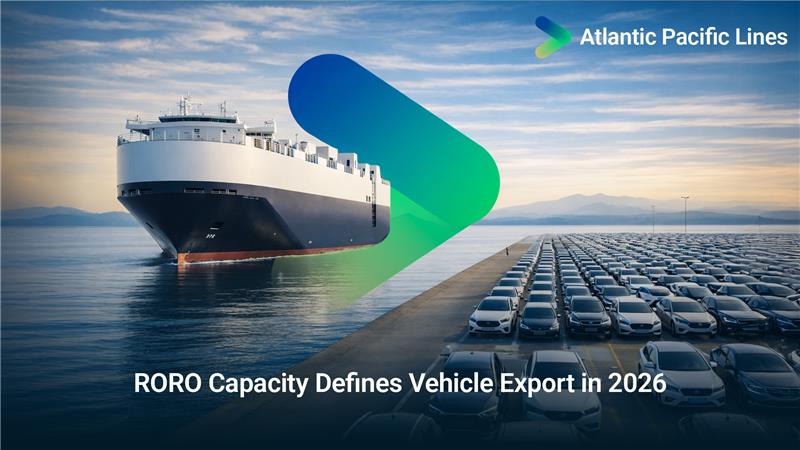
Introduction: Vehicle Trade Is Expanding, But Not Evenly
Global vehicle exports have entered a structurally different phase. Over the past two years, automotive production has normalized following semiconductor shortages, while electric vehicle manufacturing capacity has accelerated across Asia, Europe, and North America. At the same time, used vehicle exports from the United States, Japan, and Europe remain active into Africa, the Middle East, and parts of Latin America.
The result is not simply higher volumes. It is directional concentration.
Certain corridors are tightening. Certain ports are experiencing longer berth windows. Pure Car and Truck Carrier deployment is being optimized around predictable trade flows. In this environment, exporters cannot rely on availability alone. They must rely on structured RoRo programs and disciplined route strategy.
This is where Atlantic Pacific Lines comes with our execution driven, capacity aligned, and route disciplined global ocean shipping.
The Structural Reality of RoRo Shipping in 2026
Roll on Roll off shipping operates differently from containerized freight.
Unlike container vessels that can load diverse commodities across multiple decks using standardized boxes, a RoRo vessel is purpose built. Capacity is configured around:
- Deck height restrictions
- Ramp weight limits
- Lashing and securing requirements
- Vehicle mix optimization
RoRo capacity is finite and specialized. When global automotive production increases or when a surge in used vehicle exports materializes, redeployment is not instant.
This is why route planning matters more than headline fleet growth.
In 2026, exporters are competing not just for space, but for position within structured sailing rotations.
Why Capacity Alone Does Not Guarantee Movement
Fleet expansion across the Pure Car and Truck Carrier segment has been underway, with newbuilds entering service globally. However, three realities shape effective capacity:
1. Trade Lane Prioritization
Carriers allocate vessels to the most commercially stable and volume predictable corridors. Asia to Europe, Asia to North America, and Europe to North America remain core routes. Secondary markets depend on feeder positioning and seasonal optimization.
If your export program sits outside primary rotations, route design becomes critical.
2. Port Infrastructure Constraints
RoRo terminals require specific ramp access, yard staging, and processing capability. Not every port can absorb increased automotive throughput efficiently. Congestion risk rises when inland evacuation is not synchronized.
3. Vehicle Mix Variability
Electric vehicles, oversized SUVs, and heavy equipment units consume different deck configurations. Improper forecasting of mix affects loading efficiency and sailing utilization.
Atlantic Pacific Lines evaluates these constraints before recommending any routing structure. Capacity without alignment leads to delay. Capacity with structure leads to predictable flow.
The Growing Importance of Route Strategy
A vehicle export program in 2026 must answer three questions:
- Is the origin port aligned with stable RoRo rotations?
- Does the route minimize transshipment or feeder dependency?
- Is inland recovery synchronized with vessel arrival windows?
Route strategy today is about risk insulation.
For example, exporters shipping from the United States to Gulf or East Coast must evaluate sailing frequency, seasonal congestion, and inland staging windows. Likewise, exporters moving vehicles from Europe into West Africa must assess vessel rotation reliability and discharge sequencing.
Atlantic Pacific Lines structures its RoRo shipping programs around these factors:
- Carrier rotation stability
- Port performance history
- Inland trucking alignment
- Cutoff discipline
- Documentation compliance
This integrated approach protects exporters from disruption that often originates outside the vessel itself.
Used Vehicle Exports Remain Structurally Strong
Used vehicle exports from North America and Japan continue to serve demand in Africa, the Middle East, and emerging economies where affordability and durability remain primary drivers.
RoRo remains the preferred mode for used vehicle shipments due to:
- Reduced handling complexity
- Lower packaging requirements
- Faster terminal throughput
- Simplified discharge processing
However, used vehicle programs are sensitive to documentation accuracy, title compliance, and port staging discipline. Errors at origin can cascade into discharge delays.
Atlantic Pacific Lines integrates documentation control, port coordination, and sailing alignment into every vehicle export movement. Ocean shipping execution begins long before the ramp lowers.
Electric Vehicles and High Value Units Require Structured Handling
Electric vehicle exports introduce additional considerations:
- Battery safety compliance
- Weight distribution planning
- Charging level requirements
- Terminal segregation protocols
RoRo carriers apply strict loading guidelines for lithium ion battery vehicles. Non compliance can result in booking rejection or reallocation.
Atlantic Pacific Lines aligns exporters with correct carrier instructions and port level compliance to prevent operational disruption.
In 2026, compliance precision is part of route strategy.
Why RoRo Outperforms Containers for Vehicles at Scale
While container shipping offers flexibility for smaller vehicle movements, RoRo remains operationally superior for volume exporters.
RoRo advantages include:
- Faster loading cycles
- Lower per unit handling cost at scale
- Reduced craning exposure
- Direct deck access
For exporters shipping consistent monthly programs, RoRo delivers structural efficiency. Containerization may suit niche shipments, but not high frequency export lanes.
Atlantic Pacific Lines evaluates shipment profile before recommending mode. The objective is not booking space. The objective is protecting throughput continuity.
Execution Discipline Defines Performance
Vehicle export success in 2026 is no longer about booking confirmation.
It is about:
- Predictable sailing alignment
- Port staging control
- Documentation accuracy
- Inland coordination
- Carrier rotation stability
Atlantic Pacific Lines operates as an ocean shipping partner focused on execution architecture. RoRo shipping is not treated as transactional freight. It is managed as a structured movement program.
This approach positions Atlantic Pacific Lines as a best ocean shipping company choice for exporters seeking long term stability, not reactive bookings.
The Strategic Outlook for 2026
Global vehicle flows are expected to remain active across:
- Asia to Europe
- Asia to North America
- United States to Middle East
- Europe to West Africa
Capacity growth is occurring, but corridor concentration means disciplined exporters will outperform reactive ones. RoRo shipping in 2026 rewards planning.
Conclusion: Route Intelligence Is the Competitive Advantage
As global vehicle exports continue to expand, RoRo capacity will remain central to efficient ocean shipping. But capacity without route intelligence is vulnerable.
Atlantic Pacific Lines structures vehicle export programs around:
- Proven carrier rotations
- Stable port performance
- Coordinated inland alignment
- Compliance first execution
For exporters evaluating their 2026 strategy, the decision is not simply which vessel has space.
It is which route structure protects your cargo from variability.
Atlantic Pacific Lines stands ready to align your vehicle export program with disciplined RoRo capacity and structured global ocean shipping execution.
Align your vehicle export program with disciplined RoRo capacity.
Ready to structure your 2026 vehicle export strategy? Let's discuss how Atlantic Pacific Lines can deliver predictable sailing alignment, port staging control, and compliance-first execution for your global ocean shipping.
Contact Us Today