Executive Summary
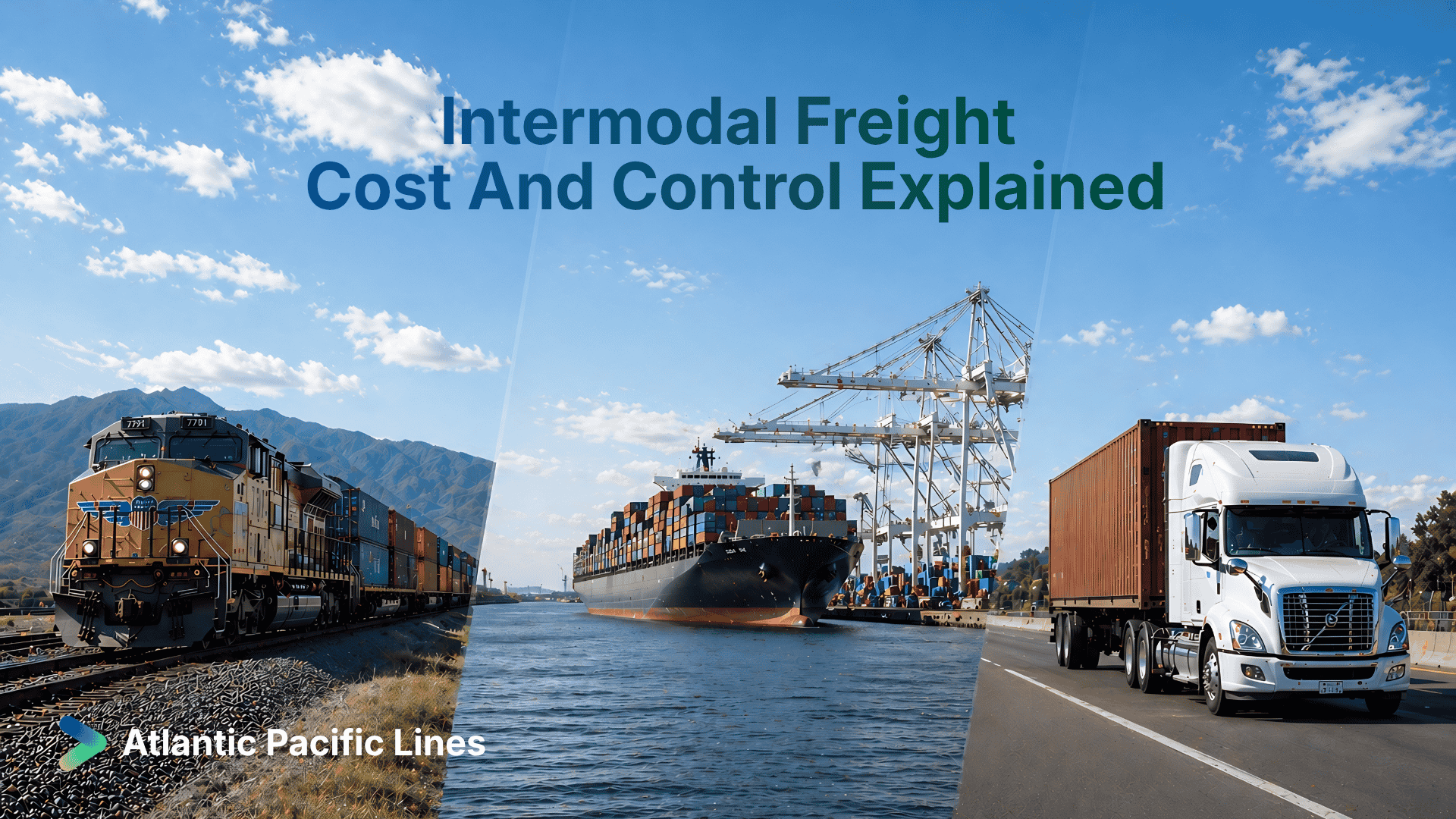
Intermodal freight is the coordinated movement of cargo using multiple transportation modes such as ocean, rail, and trucking while keeping the cargo in the same container throughout the journey.
In U.S. logistics, intermodal is not simply a transport option. It is a network design decision that impacts cost structure, transit reliability, and operational control.
The effectiveness of intermodal transport depends on three execution layers:
- Pre-arrival planning and capacity alignment
- Port clearance and transfer timing
- Inland coordination across rail and trucking
When these layers are synchronized, intermodal reduces cost and improves scalability. When they are not, delays accumulate at transfer points, where most shipments lose time and predictability.
Why Intermodal Freight Exists in Modern Supply Chains
Intermodal freight exists because single-mode transportation cannot efficiently handle long-distance inland distribution at scale.
For example, moving a container from Los Angeles to Chicago entirely by truck:
- Increases cost significantly
- Limits capacity availability
- Introduces driver and equipment constraints
By contrast, using intermodal (Ocean ? Rail ? Truck) allows:
- Cost optimization through rail linehaul
- Higher volume movement
- Better network utilization
However, this efficiency introduces complexity at transition points, which becomes the primary execution challenge.
The Intermodal Execution Model: Not Just Movement, But Coordination
At a surface level, intermodal looks like a sequence of transport modes.
In reality, it is a time-sensitive coordination system involving:
- Ocean carriers
- Port terminals
- Customs authorities
- Rail operators
- Inland terminals
- Trucking providers
Each operates independently, but the shipment depends on synchronized execution across all of them. A delay at any one point affects the entire chain.
Step-by-Step Intermodal Freight Flow With Execution Dependencies
-
1Containerization and Origin Planning
Cargo is loaded into a container and sealed. This is where intermodal success actually begins. Key decisions must already include inland destination routing, rail vs trucking strategy, and estimated arrival timing alignment. Failure to plan at origin leads to reactive decisions at the port. -
2Ocean Freight Movement and Inland Pre-Planning
During ocean transit, intermodal planning must be finalized, including rail capacity booking, terminal selection, and drayage coordination. Without this alignment, containers sit at port, storage charges begin, and rail windows are missed. -
3Port Arrival and Clearance as a Bottleneck
Customs clearance is the most critical checkpoint in intermodal execution. If clearance is delayed, rail booking becomes invalid, terminal dwell time increases, and trucking schedules collapse. Clearance must be completed before rail cutoff timing, not just before delivery. -
4Port to Rail Transfer and Terminal Constraints
Once cleared, the container is transferred from the port to a rail ramp. This stage introduces limited rail departures, terminal congestion, and equipment availability constraints. A common failure is missing rail cutoff by a few hours and incurring multi-day delays. -
5Rail Linehaul Movement
Rail handles long-distance inland movement with lower cost per mile, high capacity, and reduced fuel dependency versus trucking. Trade-off: fixed schedules, limited rerouting flexibility, and dependency on terminal operations. -
6Inland Terminal Bottlenecks
At inland terminals, delays often occur due to congestion at major rail hubs, chassis shortages, and pickup appointment delays. This stage is less visible for importers but often highly delay-prone. -
7Final Mile Delivery Risk
Final delivery is completed by trucking. Delays can still occur due to warehouse scheduling conflicts, delivery window restrictions, and driver availability. Even after successful rail movement, execution can fail in the last mile.
Where Intermodal Freight Actually Breaks in Real Operations
1. Timing Misalignment Between Modes
Intermodal depends on precision timing. If vessel arrival, clearance completion, rail cutoff, and truck scheduling are misaligned, delays compound across the chain.
2. Fragmented Visibility Across Stakeholders
Each mode operates in its own system. Without unified visibility, importers cannot see where delays are forming, which stage is causing disruption, and what corrective action is needed.
3. Cost Leakage at Transfer Points
Most hidden costs occur during waiting, not movement:
- Demurrage at the port
- Storage at terminals
- Detention on equipment
- Rebooking costs
Intermodal savings can be lost entirely if transfer points are not managed properly.
Intermodal vs Direct Trucking: A Strategic Decision Model
| Factor | Intermodal Freight | Direct Trucking |
|---|---|---|
| Cost Structure | Lower over long distances | Higher |
| Speed | Moderate | Faster |
| Flexibility | Limited | High |
| Risk Concentration | At transfer points | During transit |
| Scalability | High | Limited |
| Planning Requirement | High | Moderate |
This is not a transport decision. It is a supply chain strategy decision.
Decision Framework: When Intermodal Should Be Used
Use Intermodal When
- Inland distance exceeds cost-efficient trucking range
- Shipment volumes are consistent
- Delivery timelines allow for buffer
- Cost control is a priority
Avoid Intermodal When
- Delivery is urgent or time-sensitive
- Shipment is irregular or unpredictable
- Destination is near the port
- Coordination risk is high
What Importers Must Control to Make Intermodal Work
Intermodal success is not about choosing the right mode. It is about controlling execution across stages.
Key control points:
- Pre-booking inland capacity before vessel arrival
- Ensuring clearance readiness before port arrival
- Aligning rail schedules with port operations
- Coordinating final mile delivery in advance
This level of coordination typically requires structured freight execution across all shipment stages rather than treating each leg independently.
Expert Insight
Intermodal freight does not fail because of distance or transport mode. It fails because of lack of synchronization.
The most successful importers:
- Plan inland movement before origin departure
- Treat clearance as a timing gate, not a formality
- Maintain visibility across all stages
Those who do not experience delays at handoff points, lose cost advantage through hidden charges, and operate reactively instead of predictably.
FAQs
Need Structured Intermodal Execution Support?
Speak with Atlantic Pacific Lines to align ocean, rail, and final-mile execution for predictable inland delivery.
Schedule a Call Today